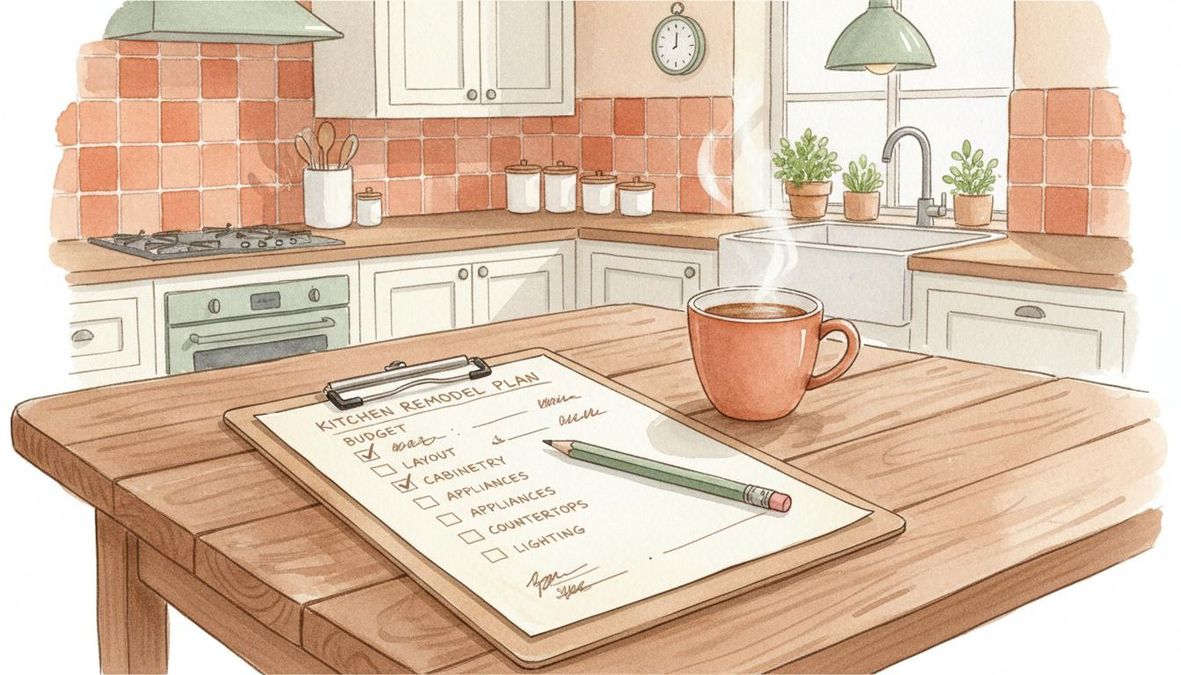
Most kitchen remodels go over budget because homeowners skip the planning phase. They start demolition before finalizing their design, order cabinets without measuring twice, or sign a contractor agreement without reading the fine print. The result is change orders, delays, and costs that spiral 20–30% beyond the original estimate.
This checklist covers every phase of a successful kitchen remodel: planning, hiring, construction, and completion. Use it as your project roadmap — print it out, check items off as you go, and don’t start the next phase until the current one is complete. The homeowners who follow a structured process are the ones who finish on time and on budget.
For a week-by-week timeline to accompany this checklist, see our kitchen remodel timeline. For help choosing your contractor, read our guide on how to choose a kitchen contractor. For budget estimates, try our kitchen remodel cost calculator.
Kitchen Remodel Steps in Order (Quick Version)
- Set your budget — total spend plus 15% contingency reserve.
- Design the space — layout, cabinets, counters, appliances, lighting.
- Get three contractor quotes — with line-item breakdowns and payment schedules.
- Sign a contract with milestone payments — never pay more than 10% upfront.
- Pull permits and order materials — cabinets alone take 6–10 weeks to arrive.
- Demolition — week 1 of construction.
- Rough-in plumbing and electrical — inspected and passed before drywall.
- Drywall, flooring, and paint — walls closed up, floor down.
- Cabinet installation — leveled, aligned, hardware attached.
- Countertop templating, fabrication, and install — 2–3 weeks total.
- Backsplash, appliances, and fixtures — the space becomes functional.
- Punch list walkthrough — sign off item by item before final payment.
That’s the shape. The rest of this page is the detailed checklist behind each step — every task, every red flag, every trap the pros know about.
Also useful:
- Week-by-week: Kitchen Remodel Timeline
- Budget by tier: Kitchen Remodel Cost by Tier
- Contractor vetting: How to Choose a Kitchen Contractor
Phase 1: Planning (Steps 1–5)
Budget & Design
- Set a total budget including 15% contingency. Your “all-in” number should include materials, labor, permits, appliances, and a buffer for surprises. If your max spend is $40,000, plan the project around $34,000 and keep $6,000 in reserve.
- Determine your financing approach. Cash, HELOC, home equity loan, or personal loan? Get pre-qualified before you start getting quotes so you know your ceiling. Our guide to kitchen remodel financing covers the options.
- Establish your “must-haves” vs “nice-to-haves.” Must-haves are non-negotiable (more storage, better workflow). Nice-to-haves are bonuses if budget allows (pot filler, wine fridge, under-cabinet lighting). When decisions get hard, this list keeps you focused.
- Measure your kitchen precisely. Measure wall-to-wall, floor-to-ceiling, window and door locations, and the position of every existing outlet, switch, and plumbing line. Your contractor will verify, but accurate initial measurements prevent design mistakes.
- Create a design board. Collect photos of kitchens you love. Note what specifically you like — the cabinet color, the hardware style, the countertop material, the lighting. Share this with your designer or contractor.
- Choose your color scheme and style direction. Traditional, modern, transitional, farmhouse? Light and bright or moody and rich? Lock this in before you shop — it eliminates half the options immediately.
- Select cabinet style and layout. Work with your contractor, designer, or the retailer’s design service to finalize cabinet specifications. Confirm every dimension, interior feature, and finish.
- Choose countertop material and color. Visit stone yards to see full slabs (for natural stone) or request large samples (for quartz). Photograph your selections with your cabinet samples together.
- Select appliances with confirmed dimensions. Measure twice, order once. Verify that your refrigerator fits through doorways and that your range works with your gas or electrical supply.
- Design lighting plan. Ambient (recessed or flush-mount), task (under-cabinet, pendants), and accent lighting. Every work surface should have adequate light.
- Choose backsplash tile and flooring. Order samples and view them in your kitchen’s natural light — colors shift dramatically between showroom and home.
- Plan for temporary kitchen setup. Designate a space with microwave, mini-fridge, coffee maker, and prep surface. You’ll need it for 6–10 weeks.
Permits & Preparation
- Confirm permit requirements with your local building department. Your contractor should handle this, but you should know what’s required.
- Notify your homeowners insurance that you’re undertaking a kitchen remodel. Confirm coverage during construction.
- Clear the kitchen completely. Remove food, dishes, furniture, and wall decorations. Protect adjacent rooms from dust with plastic sheeting.
- Photograph everything before demolition for insurance purposes and for reference if disputes arise.
Phase 1 Complete? Confirmation:
- Budget finalized with contingency
- All material selections made and ordered
- Design drawings approved
- Permits applied for or approved
- Temporary kitchen operational
Phase 2: Hiring Your Contractor (Steps 6–8)
Contractor Vetting
- Get at least three written quotes. Each quote should include detailed line items — scope of work, materials allowance, labor breakdown, permit fees, and payment schedule. A single number with no detail is a red flag.
- Verify license and insurance. Check your state contractor board’s website. Request certificates of insurance (general liability and workers’ compensation) directly from the insurance company — not from the contractor.
- Check references from 3 recent clients. Ask specifically about timeliness, communication, budget adherence, and how the contractor handled problems. Ask to see the finished work if possible.
- Review online ratings carefully. Check Google, BBB, and Yelp. Read the negative reviews — are they about communication, quality, or personality clashes? One bad review among many good ones is normal; a pattern of the same complaint is not.
- Confirm the crew is employees, not day laborers. Contractors with established teams deliver more consistent quality than those who pick up workers at the home center parking lot.
Contract Must-Haves
- Detailed scope of work. Every task, material specification, and finish should be listed. “Install cabinets” is not enough. “Install [brand] [model] semi-custom cabinets in [finish], including soft-close hinges, pull-out shelves, and [hardware style] pulls” is a proper scope.
- Payment schedule tied to milestones. Never pay more than 10% upfront or $1,000 (whichever is less). Structure payments: 10% at contract, 25% at material delivery, 25% at rough-in completion, 30% at substantial completion, 10% retainage until punch list is complete.
- Timeline with start and completion dates. Include penalties for significant delays caused by the contractor (exclusions for weather and material backorders are standard).
- Change order process. Changes happen. The contract should specify that all changes require a written change order signed by both parties before the work proceeds — no verbal agreements.
- Lien waiver provision. Your contractor should provide lien waivers from all subcontractors and suppliers upon final payment. This protects you from subcontractors placing a lien on your home if the contractor doesn’t pay them.
- Warranty terms. Workmanship warranties typically run 1 year. Material warranties come from manufacturers and vary by product.
- Cleanup and debris removal. Specify who’s responsible and how often cleanup happens.
- Right to stop work. You should be able to stop work if the contractor violates the contract, with clear terms for resolving disputes.
Before Work Begins
- Confirm material delivery dates with your contractor. Cabinets, countertops, and appliances should be on-site or en route before demolition starts.
- Walk through the project one final time with your contractor to confirm every detail.
- Establish communication protocol. Daily texts? Weekly calls? Email for formal changes? Set expectations now.
- Confirm working hours and rules: parking, bathroom access, noise restrictions, dust containment.
Phase 2 Complete? Confirmation:
- Contract signed by both parties
- Insurance and licenses verified
- Payment schedule agreed
- Material delivery dates confirmed
- Communication plan established
Phase 3: Construction (Steps 9–11)
Weekly Milestones
- Week 1 (Demolition): Old kitchen removed. Walls and subfloor inspected for hidden issues. No surprises = green light to proceed.
- Week 2 (Rough-in): Plumbing and electrical rough-in complete. Inspection scheduled and passed. This is a critical milestone — drywall can’t go up until rough-in passes.
- Week 3–4 (Drywall & Flooring): Walls repaired and painted. Flooring installed if applicable. Space prepped for cabinets.
- Week 5 (Cabinet Installation): Cabinets installed, leveled, and aligned. Hardware installed. Space ready for countertop templating.
- Week 6 (Countertops): Templating completed. Fabrication in progress (off-site).
- Week 7 (Countertop Install + Backsplash): Countertops installed. Backsplash tiled and grouted. Grout sealed.
- Week 8 (Appliances & Fixtures): All appliances installed and operational. Sink, faucet, and plumbing connections tested. Lighting installed.
- Week 9 (Final Touches): Paint touch-ups. Caulk application. Final cleaning. Punch list items addressed.
Ongoing During Construction
- Walk the job site every 2–3 days. Don’t hover, but stay informed. Take photos of progress.
- Communicate with your contractor weekly. Even if it’s just a text exchange — regular contact prevents small issues from becoming big problems.
- Document any changes in writing. If you request a change, ask for a written change order with cost and timeline impact before approving.
- Hold payment until milestones are complete. Don’t pay ahead of work completion — it removes your leverage if problems arise.
- Save all receipts, warranties, and product information. You’ll need these for maintenance, future repairs, and potential insurance claims.
Red Flags to Watch For
- Contractor requests payment ahead of schedule
- Materials don’t match what was specified
- Subcontractors complain about not being paid
- Work stops for days with no explanation
- Contractor avoids your calls or texts
- Inspections fail repeatedly
- Change orders pile up without clear documentation
If you see any of these, address them immediately. Our guide on kitchen contractor red flags covers how to handle each situation.
Phase 3 Complete? Confirmation:
- All rough-in inspections passed
- Cabinets installed and operational
- Countertops installed
- Backsplash complete
- All appliances installed and tested
- All lighting operational
- No active leaks or electrical issues
Phase 4: Punch List & Handoff (Step 12)
Punch List Walkthrough
- Schedule the walkthrough with your contractor. Do this during daylight hours when you can see details clearly. Bring your copy of the contract and specifications.
- Inspect cabinets: Doors and drawers open and close smoothly. Hardware is secure. No scratches or chips. Shelves are level and secure.
- Inspect countertops: No scratches, chips, or cracks. Seams are minimal and acceptable. Edge profiles match specification. Sink and cooktop cutouts are clean.
- Inspect backsplash and tile: Tiles are level and evenly spaced. Grout lines are consistent. Caulk at joints (counter-to-wall, around windows) is smooth and even.
- Test all appliances: Each appliance turns on, runs through a cycle, and operates as expected. Check for unusual noises or error codes.
- Test plumbing: Run water in the sink, turn on the garbage disposal, run the dishwasher through a cycle. Check for leaks under the sink and at appliance connections.
- Test electrical: Every outlet, switch, light fixture, and appliance connection works. Under-cabinet lighting operates. Range hood fan and light work.
- Check paint and walls: No missed spots, paint on cabinets or countertops, or damage to adjacent rooms.
- Check trim and caulking: All gaps are caulked. Trim is installed and painted where specified.
- Verify cleanup: Job site is clean. All debris, tools, and protective materials are removed.
- Document the punch list in writing. Both you and your contractor sign it. Set a completion date for repairs.
Final Steps
- Final inspection passed (if required by your jurisdiction).
- Punch list items completed to your satisfaction.
- Collect all warranties and manuals: Appliance manuals, cabinet care instructions, countertop maintenance guides, plumbing and electrical fixture warranties.
- Collect lien waivers from all subcontractors and material suppliers.
- Verify final invoice matches contract and approved change orders. Question any line item you don’t understand.
- Release final payment and retainage only after everything above is complete.
- Schedule follow-up: Ask your contractor to check in after 30 and 90 days to address any settling issues (cabinet door adjustments, caulk shrinkage, etc.).
- Update your homeowners insurance to reflect the improved kitchen value.
Phase 4 Complete? Confirmation:
- Punch list resolved
- Final inspection passed (if applicable)
- All warranties and manuals received
- Lien waivers collected
- Final payment released
- 30- and 90-day follow-up scheduled
Save or Print This Checklist
Bookmark this page, or use your browser’s print function (Cmd/Ctrl + P) to save the full checklist as a PDF for your contractor meeting or job binder.
The page includes:
- All 12 steps with the underlying checklist items
- 4-phase confirmation checkpoints
- Red-flag warning signs during construction
- Punch list walkthrough template
For a week-by-week schedule that pairs with this checklist, see our kitchen remodel timeline. To budget the project, use our kitchen remodel cost calculator.