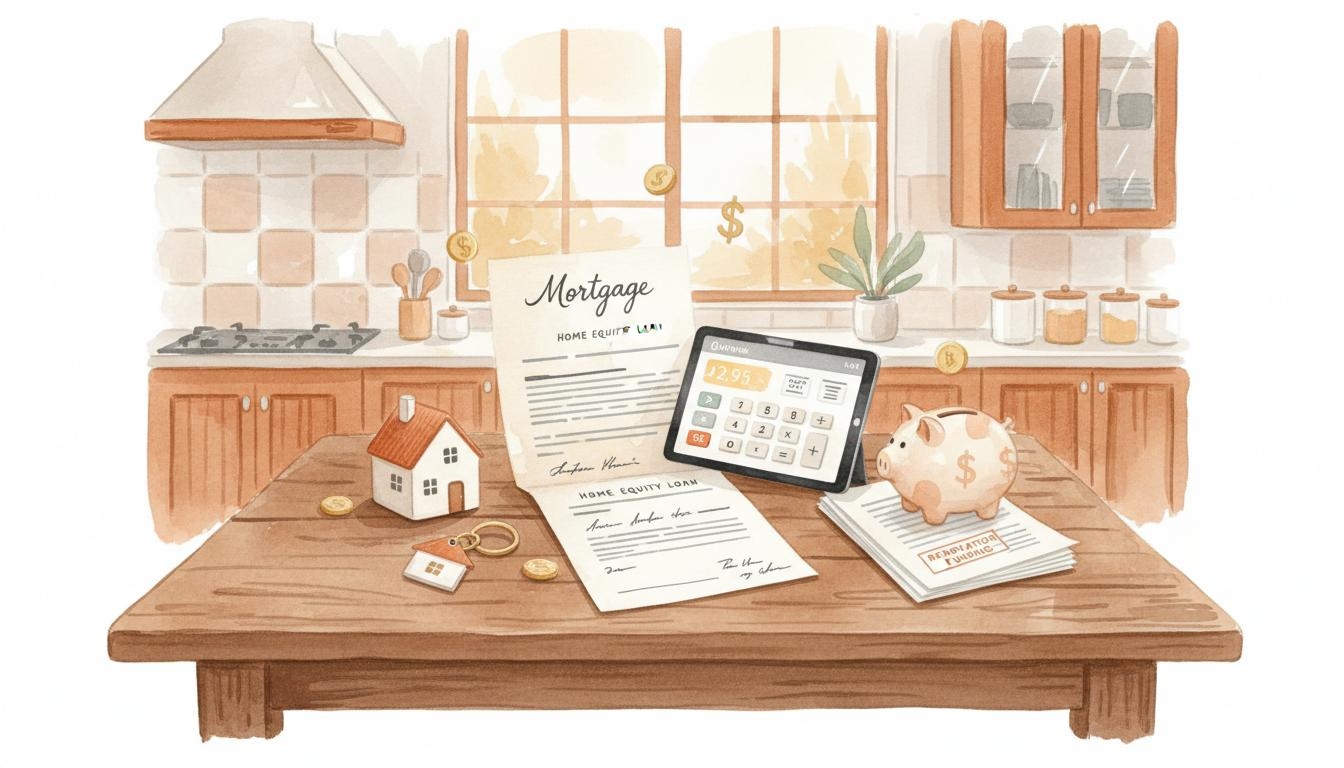
The average kitchen remodel costs between $25,000 and $50,000. Most homeowners don’t have that sitting in a checking account — and that’s completely normal. Financing a kitchen remodel is standard practice, and when done right, it lets you improve your home’s value and your daily life without draining emergency savings or retirement accounts.
The key is choosing the right financing tool for your situation. A HELOC makes sense for equity-rich homeowners. A personal loan works for recent buyers with minimal equity. Cash-out refinancing can be smart when rates are favorable — which, as of mid-2025, they are compared to the peaks of 2023–2024.
This guide covers every major financing route with current rate ranges, qualification requirements, and honest assessments of who each option serves best. For budget planning to know how much you need to finance, use our kitchen remodel cost calculator and our kitchen remodel cost by tier breakdown.
HELOC (Home Equity Line of Credit): Best for Equity-Rich Homeowners
A HELOC functions like a credit card secured by your home. You get approved for a maximum credit line, draw money as you need it during a “draw period” (typically 10 years), then repay over a “repayment period” (typically 10–20 years). You pay interest only on what you actually borrow.
Current Rates & Terms (2025)
- Interest rate: 8.0%–10.5% variable (prime rate + margin)
- Draw period: 10 years
- Repayment period: 10–20 years
- Closing costs: $0–$1,000 (many lenders waive fees for qualified borrowers)
- Tax deductibility: Interest may be deductible if funds are used to substantially improve your home (consult a tax professional)
Pros
Flexibility. Draw money as contractors invoice you, not all at once. If your remodel comes in under budget, you simply don’t use the remaining credit line. If you need more, it’s there (up to your limit) without reapplying.
Interest-only payments during draw period. Early payments are manageable because you’re only paying interest on the outstanding balance, not principal. This helps cash flow during the remodel itself.
Lower rates than unsecured options. Because your home secures the loan, lenders take less risk and charge less interest. A HELOC typically runs 2–4 percentage points below a personal loan rate.
Reusable. As you repay the balance, that credit becomes available again during the draw period. It’s an ongoing resource for future home improvements or emergencies.
Cons
Variable rates. Your interest rate adjusts with the prime rate, which means your payments can increase over time. In a rising rate environment, budget for higher payments in years 3–5 of your repayment.
Your home is collateral. Default on a HELOC and the lender can foreclose. This is real debt secured by real property — treat it seriously.
Closing costs and fees. Some HELOCs charge annual fees, inactivity fees, or early closure fees. Read the fine print. Lenders like Figure and Bank of America offer no-closing-cost HELOCs for qualified borrowers.
Who It’s Best For
Homeowners with at least 20% equity in their home after the HELOC is added (most lenders require loan-to-value of 80% or below). If your home is worth $500,000 and you owe $300,000, you have $200,000 in equity and could potentially qualify for a $100,000 HELOC.
We may earn a commission if you apply through these links, at no extra cost to you. We recommend comparing offers from multiple lenders.
Home Equity Loan: Best for Lump-Sum Borrowers
A home equity loan gives you a fixed amount of money upfront, which you repay in fixed monthly installments over a set term — typically 10–20 years. Unlike a HELOC, you can’t draw additional funds later.
Current Rates & Terms (2025)
- Interest rate: 8.25%–11.0% fixed
- Term: 10–20 years
- Closing costs: $0–$1,500
- Tax deductibility: Same as HELOC — may be deductible if used for substantial home improvements
Pros
Fixed rate and payment. Your interest rate never changes. Your monthly payment never changes. This predictability makes budgeting straightforward — especially valuable if you’re on a fixed income or prefer stability.
Lower rates than personal loans. Same collateral advantage as a HELOC — your home secures the debt, so you pay less interest.
Single disbursement. You receive the full loan amount at closing. This works well if you’re paying your contractor a large upfront deposit or if you prefer to have all funds available immediately.
Cons
Less flexible than HELOC. If your remodel costs less than expected, you’ve still borrowed (and are paying interest on) the full amount. If it costs more, you need a second loan or alternative funding.
Your home is collateral. Same foreclosure risk as a HELOC.
Higher monthly payments than HELOC initially. Because you’re repaying principal + interest from day one, monthly payments exceed HELOC minimum payments during the draw period.
Who It’s Best For
Homeowners who know their exact remodel cost (fixed-price contract with their contractor), prefer predictable payments, and have sufficient equity. If variable rates stress you out, the 0.25%–0.75% premium for a fixed-rate home equity loan may be worth paying for peace of mind.
Cash-Out Refinance: Best When Rates Work in Your Favor
A cash-out refinance replaces your existing mortgage with a new, larger mortgage. You receive the difference between your new loan amount and your old mortgage balance as cash.
Current Rates & Terms (2025)
- Interest rate: 6.5%–8.0% fixed (30-year), 6.0%–7.25% (15-year)
- Term: 15 or 30 years
- Closing costs: 2–5% of loan amount ($4,000–$10,000 on a $200,000 refi)
- Cash available: Up to 80% of home value minus existing mortgage balance
Pros
Potentially lowers your overall mortgage rate. If your current mortgage rate is higher than current market rates, a cash-out refinance can fund your remodel and reduce your monthly mortgage payment. As of mid-2025, homeowners with mortgages from 2022–2023 may benefit from this.
Lowest interest rate of all options. A primary mortgage carries a lower rate than a HELOC, home equity loan, or personal loan because it’s first in line if foreclosure occurs.
Long repayment term. Spreading repayment over 15–30 years keeps monthly payments low — though you’ll pay more total interest over the life of the loan.
Cons
Resets your mortgage clock. If you’re 8 years into a 30-year mortgage, refinancing to a new 30-year loan means you’re back at year one — adding 8 years of payments unless you pay extra principal.
High closing costs. $4,000–$10,000 in closing costs makes cash-out refinancing expensive for smaller remodels. This option works best when you’re borrowing $75,000+ and improving your mortgage rate.
Longer approval process. Refinancing takes 30–60 days versus 2–3 weeks for a HELOC or home equity loan. If your contractor wants to start next month, this timeline may not work.
Who It’s Best For
Homeowners with current mortgage rates above 7.5% who need to borrow $75,000+ and plan to stay in their home long-term. If you can lower your mortgage rate and fund your remodel in one transaction, the math often works in your favor despite the closing costs.
Personal Loan: Best for Low-Equity or Recent Buyers
A personal loan (sometimes called a home improvement loan) is unsecured — your home is not collateral. Approval is based on your credit score, income, and debt-to-income ratio.
Current Rates & Terms (2025)
- Interest rate: 10.0%–18.0% fixed (excellent credit: 8%–12%; fair credit: 14%–18%)
- Term: 3–7 years
- Origination fee: 0–8% of loan amount
- No collateral required
Pros
No equity required. Recent homebuyers with minimal equity can still qualify. Renters financing a kitchen in a rental property (with landlord permission) can use personal loans.
Fast approval and funding. Many online lenders (LendingTree, SoFi, Marcus) approve and fund within 1–3 business days. If your contractor can start next week, a personal loan delivers.
Fixed rate and term. Predictable payments with a defined end date. You’ll know exactly when this debt is gone.
Your home is not at risk. Defaulting on a personal loan damages your credit but doesn’t put your home in jeopardy. For risk-averse homeowners, this psychological benefit matters.
Cons
Higher interest rates. Unsecured debt costs more because the lender takes more risk. A personal loan at 12% costs significantly more over time than a HELOC at 9% on the same balance.
Shorter repayment term. Higher monthly payments than a HELOC or cash-out refinance because you’re repaying over 3–7 years instead of 10–30.
Origination fees. Some lenders charge upfront fees of 1–8%, which reduces the amount you actually receive. A $30,000 loan with a 5% origination fee puts only $28,500 in your account.
Borrowing limits. Most personal loans max out at $50,000–$100,000, which may not cover a large upscale remodel.
Who It’s Best For
Recent homebuyers with insufficient equity for a HELOC, homeowners who don’t want to use their home as collateral, or those funding smaller remodels ($10,000–$30,000) where the rate difference versus a HELOC is less impactful.
We may earn a commission if you apply through these links, at no extra cost to you.
Contractor Financing / Buy Now Pay Later (BNPL)
Many contractors partner with financing companies (Synchrony, GreenSky, Wells Fargo Home Projects) to offer on-the-spot financing. These are essentially personal loans or credit cards with promotional terms.
Typical Terms (2025)
- Promotional APR: 0% for 6–18 months, then 15%–29.99%
- Long-term APR: 8.99%–17.99% fixed for 5–12 year terms
- No application fee in most cases
- Deferred interest risk: If you don’t pay off the promotional balance in full by the deadline, retroactive interest applies to the original amount
Pros
Convenience. Apply through your contractor, get approved at the kitchen table, start work next week. No separate lender applications.
Promotional 0% periods. If you can pay off the balance during the promotional period, you effectively borrowed for free. This works well for smaller remodels ($10,000–$20,000) where you expect a bonus, tax refund, or other windfall within 12–18 months.
Cons
Deferred interest traps. Miss the promotional payoff deadline by even $1 and you owe retroactive interest on the entire original balance — often at 26.99% APR. This is how these programs make money. Read the terms carefully.
Higher long-term rates. If you need the full repayment term, contractor financing rates typically exceed home equity options by 2–4 percentage points.
Who It’s Best For
Homeowners who qualify for promotional 0% financing and are absolutely certain they can pay the balance before the promotional period ends. If you have any doubt about your ability to pay off quickly, choose a different option.
0% Credit Card Strategy: Best for Short-Term, Small Projects
Some homeowners put part or all of a kitchen remodel on a 0% APR credit card. This works only if you can pay off the full balance before the promotional period ends.
How It Works
Apply for a card offering 0% APR on purchases for 12–21 months. Use it for materials and contractor payments. Pay it off before the promotional period ends.
The Risks
- Credit limit: Most cards offer $5,000–$25,000. A full kitchen remodel may exceed this.
- Credit utilization: A $20,000 balance on a $25,000 limit dings your credit score significantly (high utilization).
- The cliff: When the promotional period ends, rates jump to 20%–29.99%. If you haven’t paid it off, you’re in expensive debt.
Who It’s Best For
Homeowners funding a partial remodel ($10,000–$20,000), with excellent credit, and with a concrete plan to pay off the balance within 12–18 months. This is not a strategy for $50,000 remodels unless you’re using the card for a portion and paying it off aggressively.
Financing Option Comparison Table
| Option | Rate Range | Term | Collateral | Best For | Risk Level |
|---|---|---|---|---|---|
| HELOC | 8.0%–10.5% (variable) | 20–30 years | Home | Equity-rich homeowners | Moderate |
| Home Equity Loan | 8.25%–11.0% (fixed) | 10–20 years | Home | Fixed-rate preference | Moderate |
| Cash-Out Refi | 6.5%–8.0% (fixed) | 15–30 years | Home | Rate reduction + remodel | Moderate |
| Personal Loan | 10.0%–18.0% (fixed) | 3–7 years | None | Low/no equity | Low |
| Contractor Financing | 0% promo, then 15%–30% | 6 mo–12 yr | None | Short-term 0% certainty | High (deferred interest) |
| 0% Credit Card | 0% promo, then 20%–30% | 12–21 mo | None | Small, short-term projects | High (rate cliff) |