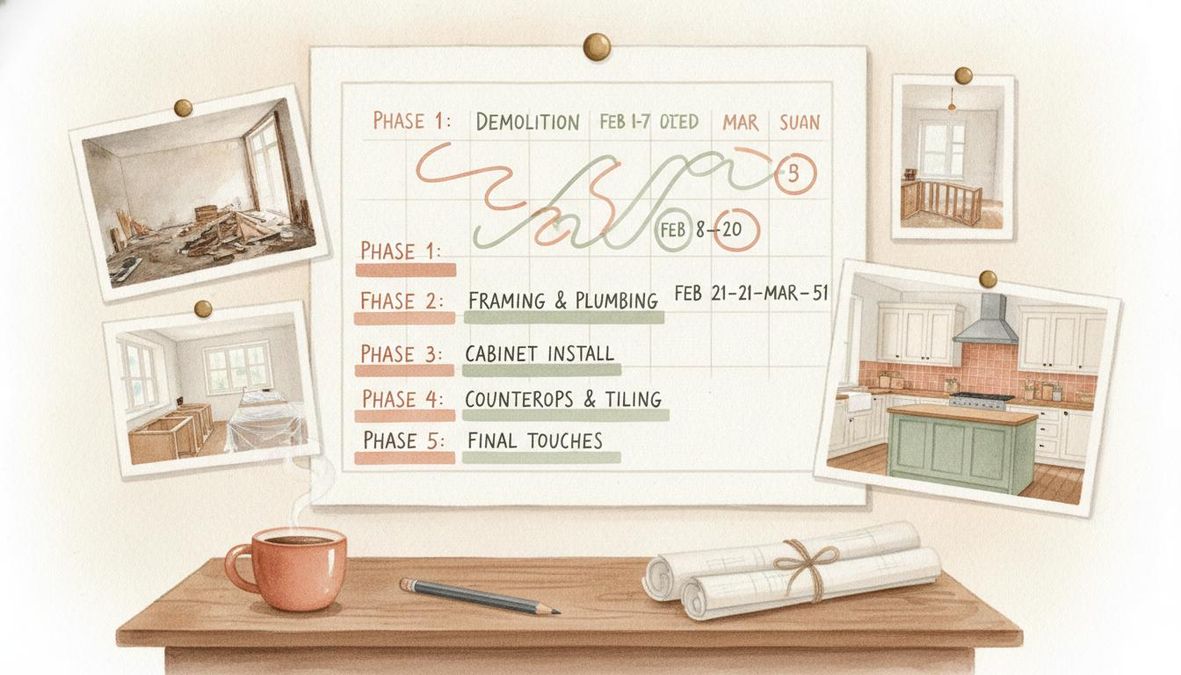
Most kitchen remodels take 6 to 12 weeks from the first swing of the sledgehammer to the final walkthrough. The range depends on your project’s scope, your contractor’s availability, and how smoothly permits and inspections go. A simple cabinet-and-counter swap might wrap in 3–4 weeks. A full gut with structural changes, custom cabinets, and stone countertops will push 12–16 weeks.
This timeline breaks down each phase of a typical mid-range kitchen remodel — the kind most homeowners undertake. Use it to set expectations, coordinate your life around the disruption, and spot potential delays before they derail your project. For budget planning alongside your timeline, see our kitchen remodel cost calculator.
Planning Phase: Weeks 1–3
What Happens
This is the phase homeowners want to rush and contractors want to extend. Good planning prevents the expensive mistakes that happen when decisions get made under pressure.
Week 1: Finalize your design. Confirm cabinet layout, appliance locations, lighting plan, and material selections. Your contractor or kitchen designer creates detailed drawings showing every cabinet dimension, electrical outlet, and light switch location.
Week 2: Order long-lead items. Custom or semi-custom cabinets typically take 4–10 weeks to manufacture. Stone countertops require templating after cabinets are installed, then 1–2 weeks for fabrication. Order these items now, before demolition starts.
Week 3: Submit permit applications. Your contractor handles this, but you should know what’s being submitted and when approvals are expected. Most jurisdictions issue permits within 1–2 weeks for straightforward kitchen remodels. Complex projects involving structural changes or electrical service upgrades may take 3–4 weeks.
Who Does the Work
You, your kitchen designer (if hired), and your contractor. This phase is collaborative — expect multiple meetings, emails, and decisions.
Timeline Tip
Don’t start demolition until your cabinets are at least in production with a confirmed delivery date. Starting demolition with no cabinets on order is how projects add 4–6 weeks of unnecessary downtime.
Phase Complete? Checklist
- Final design drawings approved and signed
- Cabinet order placed with confirmed delivery date
- All appliances ordered and delivery scheduled
- Permit applications submitted or approved
- Contractor start date confirmed in writing
- Temporary kitchen setup arranged
Demolition: Week 4
What Happens
The old kitchen comes out. Cabinets, countertops, appliances, flooring, backsplash, and sometimes drywall. For a day or two, your house looks like a construction zone — because it is.
Who Does the Work
The general contractor’s crew, sometimes supplemented by a demolition specialist for complex removals.
How Long It Takes
1–3 days for a standard kitchen. Complex demolitions (tile removal requiring surface preparation, plaster walls, asbestos-containing materials) can extend to a week.
Timeline Tip
Order a dumpster or confirm debris removal before demolition starts. Your contractor should handle this, but verify. A pile of old cabinets in your driveway is a problem if pickup gets delayed.
Phase Complete? Checklist
- Old kitchen fully removed
- Debris hauled away
- Subfloor/walls inspected for damage or surprises
- Electrical/plumbing rough-in locations marked
Rough-In Work: Weeks 4–6
What Happens
Plumbers relocate water supply and drain lines. Electricians run new circuits, relocate outlets, install under-cabinet wiring, and rough-in lighting. If you’re moving walls, framing happens here too. HVAC modifications (range hood venting, ductwork changes) are completed.
Who Does the Work
Licensed subcontractors — plumber, electrician, HVAC technician. Your general contractor coordinates their schedules.
How Long It Takes
3–10 days depending on complexity. Simple updates (keeping appliance locations, adding a few outlets) take 3–5 days. Full rewiring, plumbing relocation, and structural changes take 1–2 weeks.
Timeline Tip
This is where most delays start. Subcontractors juggle multiple jobs, and yours can get bumped if another project runs long. Ask your contractor to confirm rough-in dates 1 week in advance, not the day before.
Phase Complete? Checklist
- Plumbing rough-in complete and pressure-tested
- Electrical rough-in complete
- HVAC rough-in complete (range hood venting, etc.)
- Framing complete (if applicable)
- Inspection passed (if required by jurisdiction)
Inspection: Days Within Week 6
What Happens
Your local building inspector reviews the rough-in work to ensure it meets code. Electrical, plumbing, and sometimes framing inspections happen separately or together depending on your jurisdiction.
Who Does the Work
The building inspector. Your contractor must be present and has all work exposed and accessible.
How Long It Takes
The inspection itself takes 30–60 minutes. Scheduling it can take 1–5 business days depending on inspector availability.
Timeline Tip
Failed inspections add days. Make sure your contractor has addressed every code requirement before calling for inspection. Common failures: insufficient electrical circuits, improper drain slopes, missing nail plates on electrical wires through studs.
Drywall, Flooring & Prep: Weeks 6–7
What Happens
Drywall is repaired or replaced where walls were opened for rough-in work. Flooring is installed if it runs underneath cabinets (hardwood, tile, luxury vinyl plank). If you’re keeping existing flooring, this phase is shorter — just wall repair and painting.
Who Does the Work
Drywall crew, flooring installer, painter. Sometimes the general contractor’s crew handles drywall and paint.
How Long It Takes
Drywall: 2–3 days (including drying time between mud coats). Flooring: 2–4 days depending on material. Painting: 1–2 days.
Timeline Tip
If you’re installing hardwood or tile that requires acclimation, this must happen before installation. Hardwood needs 3–7 days to acclimate to your home’s humidity. Factor this into your timeline or the flooring contractor will delay the job.
Phase Complete? Checklist
- Drywall finished and painted
- Flooring installed (if applicable)
- Walls and ceiling painted in kitchen area
- Space cleaned and prepped for cabinet delivery
Cabinet Installation: Weeks 7–8
What Happens
Your cabinets arrive and are installed. This is the moment your kitchen starts looking like a kitchen again — even if there’s no sink or countertops yet.
Who Does the Work
The general contractor’s crew or a specialized cabinet installer. Complex custom cabinetry may be installed by the cabinetmaker’s own team.
How Long It Takes
2–4 days for a standard kitchen. Custom cabinetry with complex features (integrated lighting, appliance panels, detailed trim) takes 4–6 days.
Timeline Tip
Inspect every cabinet box before installation begins. Damage from shipping happens — and it’s much easier to reject a damaged cabinet before it’s screwed to your wall. Check for scratches, dents, and finish inconsistencies.
Phase Complete? Checklist
- All cabinets installed and level
- Doors and drawers aligned and operating
- Hardware installed
- Cabinet interior protective wrapping removed
- Space ready for countertop templating
Countertop Templating & Installation: Weeks 8–9
What Happens
A fabricator visits to create a precise template of your cabinet layout. Stone countertops (quartz, granite, marble) are fabricated off-site using this template. The installation happens 1–2 weeks later.
Who Does the Work
A countertop fabricator and installation crew. Your general contractor coordinates the templating appointment — you must have cabinets fully installed before templating.
How Long It Takes
Templating: 1–2 hours. Fabrication: 5–10 business days. Installation: 3–6 hours.
Timeline Tip
You must be present for templating — decisions about edge profiles, overhangs, seam placement, and cutout dimensions happen in real time. Come prepared with photos of your slab (if you selected a specific one) and clear instructions for the fabricator.
Phase Complete? Checklist
- Template created and approved
- Slab selected (if natural stone)
- Countertops installed
- Sink and cooktop cutouts completed
- Seams acceptable and minimal
Backsplash & Tile Work: Weeks 9–10
What Happens
Tile or other backsplash material is installed behind countertops, ranges, and sinks. Grout is applied and sealed. This phase also includes any floor tile work if it wasn’t completed earlier.
Who Does the Work
A tile setter or your general contractor’s crew if the scope is simple (subway tile, basic layouts). Complex patterns, mosaic sheets, or natural stone tile requires a specialist.
How Long It Takes
2–4 days including grout curing time. Complex tile patterns add 1–2 days.
Timeline Tip
Let grout cure fully (typically 48–72 hours) before exposing it to moisture or heavy cleaning. Your contractor should seal the grout before considering this phase complete — unsealed grout stains within weeks in a kitchen environment.
Phase Complete? Checklist
- Backsplash tile installed and grouted
- Grout sealed
- Floor tile complete (if applicable)
- Tile edges and corners properly finished
Appliance & Fixture Installation: Weeks 9–10
What Happens
Appliances are delivered and connected. The sink, faucet, garbage disposal, and any built-in features (water line to fridge, pot filler) are installed and tested. Light fixtures, under-cabinet lighting, and ventilation are connected.
Who Does the Work
Your general contractor’s crew for most installations. A plumber connects the sink and water lines. An electrician connects appliances requiring hardwiring (some dishwashers, wall ovens, cooktops) and installs light fixtures.
How Long It Takes
1–2 days. Complex appliance configurations (panel-ready refrigeration, built-in coffee machines, pot fillers) extend to 3 days.
Timeline Tip
Appliance delivery timing is critical. Deliver too early and they’re in the way of other trades. Deliver too late and trades sit idle waiting. Coordinate with your contractor — appliances should arrive the day before installation, not the week before.
Phase Complete? Checklist
- All appliances installed and operational
- Sink and faucet connected and leak-tested
- Garbage disposal installed
- Refrigerator water line connected
- All lighting operational
- Range hood vented and operational
Final Inspection & Punch List: Weeks 10–12
What Happens
A final building inspection confirms all work meets code. Then you and your contractor walk through the entire project, noting any issues — paint touch-ups, cabinet adjustments, caulk gaps, incomplete trim — on a punch list. The contractor has a specified period (usually 1–2 weeks) to resolve everything.
Who Does the Work
Building inspector for the inspection. You and your contractor for the punch list walkthrough. Contractor’s crew for punch list repairs.
How Long It Takes
Final inspection: 30–60 minutes. Punch list walkthrough: 1–2 hours. Punch list repairs: 1–5 days depending on item count.
Timeline Tip
Don’t release final payment until the punch list is fully resolved. Hold back 5–10% of the total contract value as retainage until you’re satisfied. This is standard practice and your contractor expects it.
Phase Complete? Checklist
- Final inspection passed
- Punch list items completed
- All debris and tools removed
- Final cleaning completed
- Warranties and manuals provided
- Final payment released
What Causes Delays (And How to Prevent Them)
Material backorders. Custom cabinets currently run 8–12 weeks. Some quartz colors are backordered. Order everything with confirmed delivery dates before starting demolition.
Inspection delays. Inspectors book 3–5 days out in busy markets. Failed inspections require re-inspection, adding a week. Ensure your contractor is confident before calling for inspection.
Change orders. The “while you’re at it” additions that seem small but cascade: adding a pendant light means new electrical, which means another inspection, which means the painter comes back. Minimize changes once work starts.
Subcontractor scheduling. Plumbers and electricians work 3–5 jobs simultaneously. If their previous job runs long, yours starts late. Build buffer days into your timeline.
Hidden conditions. Water damage under old flooring, asbestos in vintage materials, knob-and-tube wiring behind walls. Your contractor can’t predict these, but a thorough pre-construction inspection can surface some of them. Budget a 10–15% contingency for surprises.