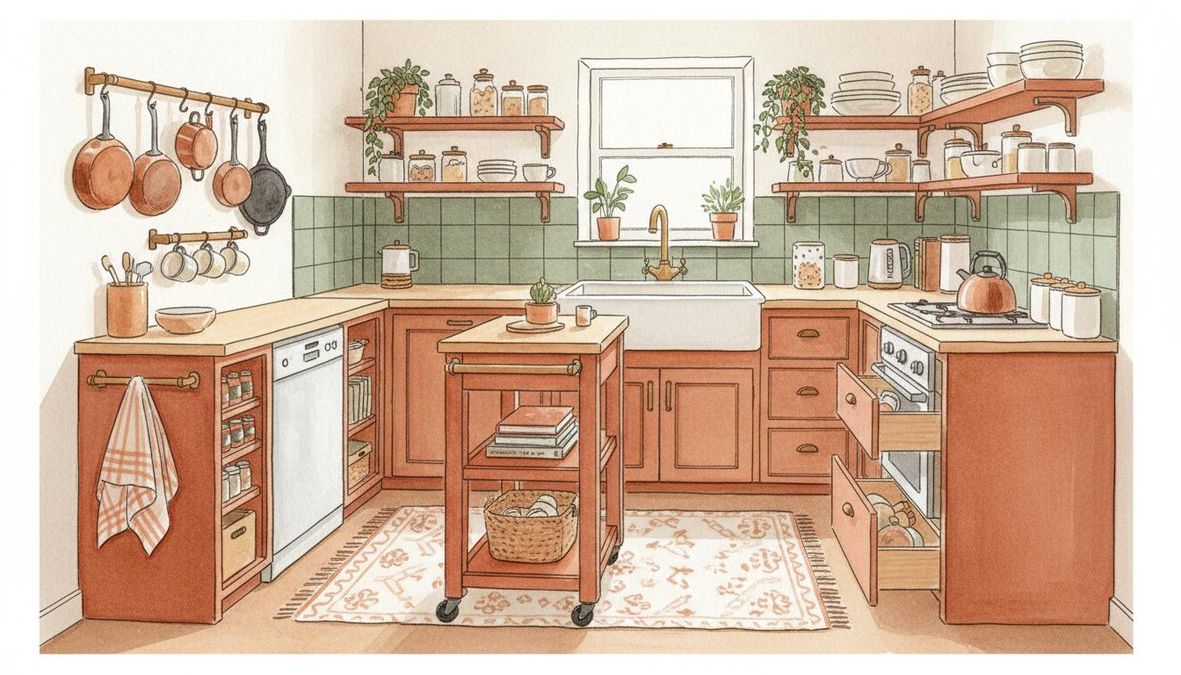
A small kitchen island can work in as little as 100 square feet — if you respect clearances. Most homeowners assume islands demand open-concept kitchens and 300+ sq ft layouts, but that is not the whole story. The right small kitchen island adds prep space, storage, and even seating without swallowing your floor plan. The trick is choosing the right footprint, respecting walkway widths, and matching the island to how you actually cook.
This guide covers 10 small kitchen island ideas that fit real kitchens, from rolling carts that tuck away to fixed narrow islands with built-in seating. We will walk through minimum clearances, real cost ranges, and when a peninsula or cart makes more sense than a fixed island. For a broader look at pricing and built-in island options, see our guide to kitchen island cost and design.
Minimum Clearance Rules: What “Small” Actually Means
Before you pick a style, you need to know whether your kitchen can handle any island at all. Here are the hard numbers that determine if a small kitchen island is feasible in your space.
Walkway Clearances
- Working side (fridge, range, sink wall): 42 inches minimum between the island edge and countertop. This gives you enough room to open appliance doors, load the dishwasher, and work at the counter without stepping sideways.
- Secondary sides (traffic paths, walls): 36 inches minimum. This is the absolute floor — any less and two people cannot pass each other comfortably.
- Seating overhang side: Allow 36 inches from the edge of the counter to the nearest wall or cabinet behind the seated diner. Anything tighter makes it hard to push a chair back.
Minimum Useful Footprint
A functional small kitchen island needs to be at least 24 inches wide by 40 inches long. Below 24 inches, you do not have enough depth for a useful work surface or drawer storage. Below 40 inches, you cannot fit standard-depth base cabinets underneath. If you are adding seating, budget at least 36 inches of length per diner for knee space.
These rules come from the National Kitchen and Bath Association (NKBA) guidelines and the practical realities of working in tight kitchens. Ignore them and you will hate the island every time you open the oven door.
10 Small Kitchen Island Ideas That Fit Tight Spaces
We have grouped these by how they function, from seating-focused to prep-focused to budget-friendly DIY builds. Each includes a realistic cost range based on a mid-2026 US market. Prices vary by region, finish choices, and whether you hire a pro or do the work yourself. Always get local quotes before committing.
Narrow Island With Seating
A long, narrow island — typically 24–30 inches wide and 60–72 inches long — runs parallel to your main counter wall. One side houses storage (drawers, shelves, or cabinets). The other side has a 12-inch overhang for seating with backless stools that tuck underneath.
This layout shines in galley kitchens where the long dimension of the room works with a narrow island rather than against it. Seating is limited — two stools at most in most cases — but it gives you a casual breakfast spot and extra prep surface without choking the aisle.
Cost range: $1,200–$4,500 (materials + installation)
Rolling or Portable Island
A rolling kitchen cart on casters is the ultimate flexibility play. Move it against the wall when you need floor space. Roll it to the center when you are prepping a big meal. Many models have drop leaves, towel bars, and open shelving below.
Look for carts with locking casters so the unit stays put when you are chopping. Steel or hardwood frames hold up better than particleboard. Some higher-end models include butcher block tops or granite-look surfaces.
Cost range: $150–$800
We may earn a commission if you purchase through these links, at no extra cost to you.
Butcher Block Top Island
A butcher block island gives you a dedicated cutting and prep surface right where you need it. You can buy a ready-made unit or convert a pair of base cabinets into an island by topping them with a custom-cut hardwood slab.
Maple and oak are the most common choices. Expect to oil the surface regularly to prevent drying and cracking. The warm wood look works especially well in farmhouse, cottage, or transitional kitchens where a stone-topped island would feel too heavy.
Cost range: $600–$3,000 (prefab); $400–$1,800 (DIY with base cabinets + block top)
Drop-Leaf Expandable Island
The drop-leaf island is the transformer of the small kitchen world. With leaves down, it functions as a slim 18–24 inch prep station. With leaves up, it expands to 36+ inches for dining, baking, or extra workspace when guests are over.
This is ideal for kitchen-dining combos where you occasionally need a table but do not have room for one permanently. The downside: you need clear wall or floor space for the leaves to swing out, which not every small kitchen can spare.
Cost range: $250–$1,200
Island-as-Prep-Zone
Some small kitchens do not need more seating — they need more counter space. A prep-focused island strips out seating entirely and dedicates every inch to workspace and storage. Think 24×48 inches with a quartz or laminate top, deep drawers for pots and pans, and maybe a power outlet for small appliances.
If your main counter run is consumed by a range and sink, this type of island gives you an uninterrupted surface for chopping, rolling dough, and staging ingredients. For layout ideas on integrating an island into your overall kitchen plan, read our guide to kitchen design with an island.
Cost range: $800–$4,000
Small Island With Sink
Adding a sink to a small kitchen island is ambitious but doable if you have the plumbing access. A prep sink — smaller than your main kitchen sink — lets one person wash vegetables or rinse dishes while another uses the main sink.
This only works if you can run water supply and drain lines through the floor, which is far easier in a slab foundation or raised subfloor than in a basement with finished ceilings below. Budget extra for a plumber. The island itself needs to be at least 30 inches wide to accommodate the sink basin and landing space on both sides.
Cost range: $2,000–$8,000 (including plumbing)
Two-Tier Island
A two-tier island splits the surface into a lower prep level (standard counter height, 36 inches) and a raised bar level (42 inches) that faces the living area. The raised tier hides dishes on the prep side from sightlines into adjacent rooms.
In a small kitchen, the two-tier design is a trade-off. You gain the visual barrier and casual seating at the bar level, but you lose continuous counter space. The footprint is typically 36×60 inches minimum to make both levels useful. This is better suited to kitchens on the larger end of “small” — say 150–180 sq ft.
Cost range: $1,500–$5,500
Slim Peninsula Alternative
Sometimes the best island is not an island at all. A peninsula attaches to an existing counter or wall on one end, creating an L-shaped workspace with an overhang for seating. Because it uses a wall for support, a peninsula eats less floor area than a freestanding island while delivering similar benefits.
You need roughly 36 inches of walkway clearance on the open side, same as an island. The seating side typically extends 36–48 inches from the wall. If your kitchen is a narrow galley or U-shape with one open end, a peninsula is often the smarter play than squeezing in a standalone island.
Cost range: $1,000–$5,000 (depending on countertop material and base cabinet count)
IKEA Hack Island
IKEA kitchen base cabinets — especially the SEKTION line — are a go-to for budget island builds. Two 24-inch base cabinets side by side create a 48-inch island. Add a custom countertop from IKEA, a local fabricator, or a salvaged butcher block slab, and you have a functional island for a fraction of custom cabinetry pricing.
IKEA hackers often add custom panels, legs, or trim to make the island look built-in. The SEKTION system offers drawer organizers, pull-out shelves, and interior fittings that punch above its price point. The catch: you are doing the assembly and finishing work yourself or hiring a handyman.
Cost range: $400–$2,500
DIY Base Cabinet Conversion
For the hands-on homeowner, converting stock base cabinets into a kitchen island is a straightforward weekend project. Buy two 24-inch unfinished base cabinets from a home center, bolt them together, add a plywood base for stability, shim to level, and top with a laminate or butcher block countertop.
Finish the exposed sides with matching cabinet panels or beadboard for a custom look. Add furniture-style legs on the seating side if you want an overhang. The result is a solid, permanent island that costs a fraction of a custom build. Do not skip the electrical — if you want an outlet in the island, hire an electrician to wire a code-compliant pop-up or side outlet.
Cost range: $300–$2,000
Comparison: 10 Small Kitchen Island Ideas at a Glance
| Island Idea | Footprint | Seating | Cost Range |
|---|---|---|---|
| Narrow island with seating | 24–30” × 60–72” | 2 stools | $1,200–$4,500 |
| Rolling/portable island | 18–30” × 30–48” | 1–2 stools (some models) | $150–$800 |
| Butcher block top island | 24–36” × 40–72” | Optional | $400–$3,000 |
| Drop-leaf expandable | 18–24” × 36–60” (closed) | 2–4 with leaves up | $250–$1,200 |
| Island-as-prep-zone | 24–30” × 48–72” | None | $800–$4,000 |
| Small island with sink | 30–36” × 48–72” | None | $2,000–$8,000 |
| Two-tier island | 36” × 60–72” | 2–3 at bar level | $1,500–$5,500 |
| Slim peninsula | 24–36” × 36–72” (from wall) | 2–3 stools | $1,000–$5,000 |
| IKEA hack | 24–48” × 36–72” | Optional | $400–$2,500 |
| DIY base cabinet conversion | 24–48” × 36–72” | Optional | $300–$2,000 |
Use this table to quickly narrow down which ideas fit your kitchen dimensions, seating needs, and budget. Remember that prices vary by region and material selection.
When a Peninsula or Rolling Cart Beats a Fixed Island
A fixed island is not always the right call. Here is how to tell.
Choose a rolling cart if your kitchen is under 120 sq ft, you need the floor space for multiple cooks, or you want the flexibility to rearrange. Carts also make sense in rentals where you cannot modify flooring or plumbing.
Choose a peninsula if your kitchen has one open wall or doorway and the rest is bounded by cabinets. Peninsulas need less floor space and often simplify electrical and plumbing runs since one end is anchored to existing structure.
Choose a fixed island if you have at least 36 inches of clearance on all sides, want permanent storage and countertop space, and plan to stay in the home long enough to justify the investment. Fixed islands also handle heavier countertop materials like quartz and granite without wobbling.
Be honest about your kitchen workflow. A poorly placed island that blocks the triangle between sink, stove, and fridge will frustrate you every single day.
Lighting for Small Kitchen Islands
Even a compact island needs proper lighting. A single pendant centered over the island provides task light for prep work and defines the zone visually. In a small kitchen, keep the pendant compact — a wide drum or oversized fixture can overwhelm the space.
For guidance on sizing and placement, see our article on pendant lighting for kitchen island. If your ceilings are low (8 feet or under), consider semi-flush mounts or mini pendants rather than hanging fixtures that intrude on headroom.
FAQ
What is the smallest kitchen that can fit an island? A kitchen as small as 100 sq ft can accommodate a compact island if you maintain 36–42 inches of walkway clearance on all sides. At this size, a rolling cart or a narrow 24×40 inch fixed island is typically your best option.
How much does a small kitchen island cost? Small kitchen islands range from about $150 for a basic rolling cart to $8,000 for a fixed island with plumbing and a stone countertop. Most homeowners spend between $800 and $3,500 for a functional island with storage.
Can you put seating on a small kitchen island? Yes, but you need enough length and overhang. Budget at least 36 inches of counter length per diner and a 12-inch overhang for knee space. A 60-inch island comfortably seats two; a 72-inch island can seat two to three with backless stools.
Is 24 inches wide enough for a kitchen island? Twenty-four inches is the minimum usable width for a kitchen island. It provides enough depth for a standard countertop with a small overhang, but it does not leave room for a sink or appliances underneath. For prep and storage only, 24 inches works fine.
Should I get a rolling island or a fixed island? Get a rolling island if you need flexibility, have under 120 sq ft, or are renting. Choose a fixed island if you want permanent storage, plan to use heavy countertops, and have the floor space to maintain proper clearances around all sides.
Can I install a sink in a small kitchen island? Yes, but the island needs to be at least 30 inches wide to fit a prep sink with landing space. You also need plumbing access through the floor, which adds $500–$2,000 to the project depending on your home’s layout.
What countertop material works best for a small island? Butcher block and laminate are the most practical for small islands because they are affordable, lightweight, and easy to cut to custom sizes. Quartz and granite work too but add weight and cost. Choose based on how you use the surface — heavy prep favors butcher block; low-maintenance durability favors quartz.
How do I add electrical to a kitchen island? The National Electrical Code requires at least one outlet in any kitchen island. For a small island, the easiest approach is a side-mounted outlet or a pop-up outlet in the countertop. Both require running conduit or cable from a nearby wall or floor box, which should be done by a licensed electrician.