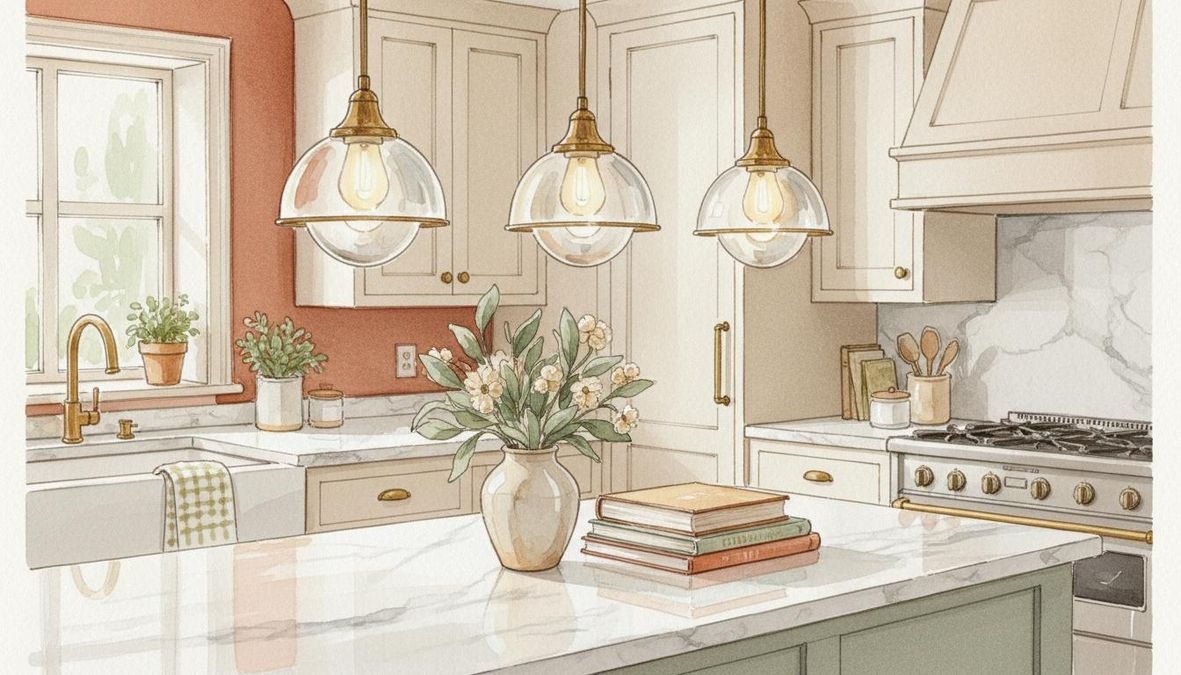
The right pendant lighting for kitchen island spaces does more than brighten a countertop. It anchors the room visually, defines the kitchen’s personality, and turns a workspace into a place people want to gather. Whether you’re swapping outdated fixtures or adding pendants to a new island, getting the details right — spacing, height, style, and cost — saves you from expensive do-overs.
This guide covers how to space fixtures, what to expect at every price tier, which bulbs work best, and five solid picks across the most popular style categories. If you’re still early in planning, our kitchen remodel cost calculator can help you budget the full project.
Why Pendant Lighting for Kitchen Island Matters
Pendant lighting for a kitchen island serves three jobs at once. First, they deliver task lighting — the focused, shadow-free illumination you need for chopping vegetables, reading recipes, and helping kids with homework. Second, they provide ambient light that warms up the room and keeps the space from feeling like a commercial kitchen. Third, they act as a visual anchor, drawing the eye to the center of the room and giving your kitchen a sense of intention and finish.
Recessed ceiling lights alone don’t cut it over an island. They cast shadows from your body onto the counter exactly where you need light most. Pendants solve this by bringing the light source down to roughly eye level, illuminating the workspace from above without interference. Done well, they also add personality — sleek metal for a modern kitchen, seeded glass for a farmhouse feel, raw fixtures for an industrial edge.
The decision becomes more complex as islands grow larger. A single pendant over a 6-foot island looks lost. Three pendants over a 4-foot island feel crowded. Matching fixture style to your broader kitchen design with an island helps the room feel cohesive rather than pieced together.
How to Space Pendant Lights Over Your Island
Getting the spacing right matters more than most homeowners expect. Hang a fixture too high and it loses its task-lighting power. Too low, and it blocks sightlines across the kitchen. Here are the rules that designers and electricians follow.
Height above the counter. The bottom of the pendant should sit 30 to 36 inches above the island countertop. For ceilings taller than 9 feet, add 3 inches of height for every additional foot of ceiling. With 10-foot ceilings, aim for 33 to 39 inches above the counter.
Spacing between fixtures. When hanging multiple pendants, leave 24 to 30 inches between the edges of each fixture. Wider pendants need more breathing room.
Centering formula. Divide your island length by the number of pendants plus one. The result gives you the distance from each end of the island to the center of the nearest pendant. A 72-inch island with two pendants: 72 divided by 3 equals 24 inches from each end, leaving 24 inches between fixtures. A 90-inch island with three pendants: 90 divided by 4 equals 22.5 inches from each end.
These measurements assume standard 36-inch-tall countertops. If your island uses a raised bar at 42 inches, adjust accordingly. When in doubt, have a helper hold the fixture in place before committing to the junction box location.
What Pendant Lighting Costs: Budget to Designer Tiers
Pendant pricing spans a wide range. Understanding the tiers helps you set realistic expectations before you start browsing.
Budget: $40–$100 per fixture. At this level, you’ll find simple metal pendants, basic glass globes, and reproduction farmhouse fixtures from big-box retailers. Materials tend to be lighter-weight metals and mass-produced components. These fixtures function reliably — they’re just less distinctive and may use thinner hardware. Brands like Globe Electric, Hampton Bay, and basic Westinghouse models dominate this range.
Mid-Range: $100–$300 per fixture. This is where quality steps up. You’ll find thicker metal finishes, hand-blown glass, better hardware, and designs that look intentional rather than generic. Most homeowners land here because it balances aesthetics, durability, and cost. Expect brands like Kichler, Progress Lighting, and mid-tier Hinkley fixtures.
Designer: $300–$1,000+ per fixture. Designer pendants use premium materials — solid brass, artisan glass, custom metalwork — and often come from well-known lighting studios. Think Schoolhouse, Rejuvenation, Visual Comfort, or Hubbardton Forge. For a three-pendant run, budget $900 to $3,000 or more just for the fixtures.
Note: Prices vary widely by region, retailer, and current availability. These ranges reflect typical US market pricing as of mid-2026. Always get local quotes for installation work and check current pricing before ordering.
Bulb Choices: LED, Dimmability, and Color Temperature
The bulb matters almost as much as the fixture. The wrong bulb looks harsh, casts unflattering shadows, or drives up your electric bill.
LED vs. incandescent. LED bulbs use roughly 75% less energy and last 15 to 25 times longer than incandescent. A 9-watt LED produces roughly the same light as a 60-watt incandescent. For pendants — fixtures you often leave on for hours — the savings add up. Quality LED bulbs now run $4–$10 each.
Dimmability. Install a dimmer switch. Full brightness for food prep, dimmed for dinner parties or late-night snacks. Not all LEDs dim smoothly, so look for bulbs labeled “dimmable” and pair them with an LED-compatible dimmer. Lutron and Legrand make reliable LED dimmers that cost $20–$40.
Color temperature. For kitchens, stick to 2,700K to 3,000K. This “warm white” range flatters skin tones and keeps the space feeling inviting rather than sterile. Above 3,500K, your kitchen starts feeling like a hospital corridor. If your open-plan kitchen flows into a living area, match the pendant color temperature to the adjacent lighting.
Brightness (lumens). Aim for 800–1,100 lumens per pendant — roughly a 60W-equivalent LED — for proper task lighting at counter height. Multiply by the number of fixtures: a three-pendant run should deliver 2,400–3,300 lumens across the island.
Five Top Pendant Styles — and One Pick in Each Category
Affiliate disclosure: We may earn a commission when you buy through links on this page. This never affects which products we recommend — picks are based on price, build quality, and fit for typical kitchen islands.
Contemporary
Contemporary pendants favor clean lines, minimal ornamentation, and sleek finishes like matte black, brushed nickel, or polished chrome. They pair well with modern kitchens featuring flat-panel cabinets, quartz countertops, and integrated appliances. Look for geometric shapes — cylinders, cones, or slim discs — that feel architectural without dominating the space.
Top pick: The Kichler Everly pendant offers a refined cylinder design in matte black or brushed nickel. It works over both small and large islands, uses standard medium-base bulbs, and typically runs $120–$180 depending on finish and retailer.
Farmhouse
Farmhouse pendants lean on classic shapes: wide bell shades, gooseneck arms, and warm metal finishes like oil-rubbed bronze or antique brass. They often feature exposed hardware, visible caging, or seeded glass that diffuses light softly. This style suits kitchens with shaker cabinets, apron-front sinks, and natural wood tones.
Top pick: The LNC Farmhouse Pendant with its wide bell shade and oil-rubbed bronze finish delivers authentic farmhouse character at a reasonable price. Expect to pay $60–$100. The seeded glass shade softens the light nicely, and the scale works well over standard 36-inch islands.
Industrial
Industrial pendants expose structure: visible sockets, metal cages, pulley systems, or weathered finishes that look like they came from a factory floor. They suit kitchens with brick accents, concrete countertops, or darker color palettes. The look is rugged and utilitarian — not delicate.
Top pick: The Westinghouse One-Light Adjustable Mini Pendant features a metal cage shade and an oil-rubbed bronze finish. Its compact size makes it ideal in sets of two or three, and it usually costs $35–$60 per fixture — an affordable way to get the industrial look without blowing the budget.
Glass Globe
Glass globe pendants soften a kitchen’s hard surfaces — cabinets, countertops, tile — with organic curves and diffused light. Clear globes create sparkle and cast defined shadows. Frosted or opal globes spread light more evenly and reduce glare. This style bridges modern and traditional kitchens, making it one of the most versatile choices.
Top pick: The Globe Electric Sophie Pendant features a mid-century-inspired opal glass globe on a matte black stem. It’s understated, works in almost any kitchen style, and typically costs $50–$80. The opal glass hides the bulb while providing even, flattering light.
Linear Bar
A linear bar pendant suspends multiple lights from a single horizontal fixture, making it ideal for longer islands where three or four individual pendants might feel busy. It simplifies installation — one electrical box instead of three — and creates a clean, organized look. Most linear bars feature adjustable-height pendants, so you can fine-tune the layout.
Top pick: The Hinkley Darcy Linear Pendant offers three adjustable lights on a sleek horizontal bar, available in brushed nickel or matte black. It suits islands 6 feet or longer and typically runs $250–$400. The integrated design eliminates the need to calculate spacing between individual fixtures.
What Installation Actually Costs
If you’re replacing existing pendants that use the same junction boxes, installation is straightforward — an electrician visit of $75–$150 handles it, often as part of a larger job.
New wiring is where costs climb. Running cable from a wall switch to the ceiling, cutting and patching drywall, and installing new junction boxes runs $75–$200 per pendant depending on ceiling height and local labor rates. A three-pendant layout with all-new wiring typically costs $300–$600 in labor, not including drywall repair and painting. Vaulted or two-story ceilings require taller ladders and longer stems, adding to the labor.
Factor installation costs into your overall island budget. If you’re building a new island from scratch, our guide to kitchen island cost and design breaks down the full expense picture.
Style Comparison at a Glance
| Style | Cost Range (Per Fixture) | Best For | Key Feature |
|---|---|---|---|
| Contemporary | $100–$300 | Modern kitchens with clean lines | Sleek geometric shapes, refined finishes |
| Farmhouse | $60–$180 | Shaker cabinets, warm wood tones | Wide bell shades, seeded glass, warm metals |
| Industrial | $35–$150 | Dark palettes, exposed materials | Metal cages, visible hardware, utilitarian look |
| Glass Globe | $50–$200 | Versatile — bridges modern and traditional | Soft diffused light, organic curves |
| Linear Bar | $200–$500 | Islands 6 feet and longer | Multiple lights on one fixture, simpler install |
Use this table to narrow your options before you start shopping. Remember that these cost ranges reflect typical US market pricing — actual prices vary by region, retailer, and availability.
Matching Pendants to Your Kitchen’s Personality
Beyond cost and spacing, the fixture you choose should feel like it belongs in your kitchen.
Consider scale. A tiny pendant over a massive island looks apologetic; an oversized fixture overwhelms a compact island. The diameter of a single pendant or width of a linear fixture should equal roughly one-third the width of your island. For a 36-inch-wide island, aim for fixtures 10 to 12 inches in diameter.
Repeat materials. If your cabinet hardware is brushed nickel, a brushed nickel pendant ties the room together. You don’t need to match everything exactly — mixing two related metal finishes adds depth. Three or more competing finishes look accidental.
Think about maintenance. Open-bottom pendants with exposed bulbs collect dust and grease. Enclosed glass shades are easier to wipe down. If you cook frequently and your pendants hang directly over the cooking zone, prioritize easy-to-clean designs.
Layer your lighting. Pair pendants with recessed ceiling lights for general illumination and under-cabinet lighting for perimeter task work. This layered approach prevents dark spots and gives you flexibility for different times of day.
Planning the Full Island Budget?
Run the numbers in our kitchen remodel cost calculator — it factors in cabinets, countertops, lighting, and labor for your zip code, so you can see how pendant fixtures fit into the bigger picture before you commit.
Methodology note: Cost ranges in this guide reflect typical US retail pricing for mid-2026, compiled from major retailer listings and national electrician rate surveys. Regional variation is significant — labor costs in metropolitan areas often run 30–50% above national averages. We recommend verifying current pricing with local suppliers and contractors before finalizing your budget.