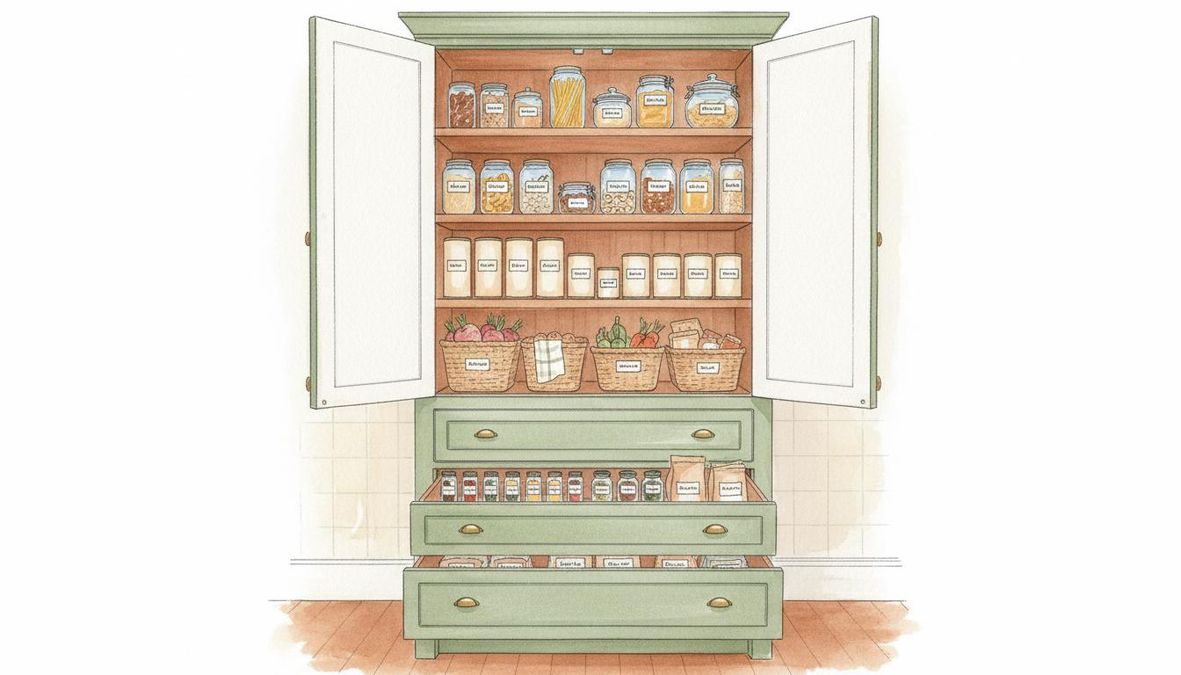
A built-in kitchen pantry cabinet runs $500–$3,500 installed. Here’s how tall, wide, and walk-in pantries compare on cost, storage, and fit for your kitchen.
The pantry is the most under-planned part of most kitchen remodels. Homeowners obsess over cabinet door styles and appliance brands — then shove food storage into whatever cavity is left over. A well-chosen kitchen pantry cabinet keeps essentials within reach and recovers square footage you’d otherwise lose to disorganized cabinets. But pantry options range from a basic $500 freestanding unit to a $5,000+ walk-in closet, and the right choice depends on your kitchen’s footprint, your cooking habits, and your budget. This guide breaks down every major pantry type, what drives the price, and how to pick the one that fits your remodel without wasting money on features you’ll never use.
Types of Pantry Cabinets and What They Cost
Pantry cabinets fall into four main categories: tall single units, wide double-door tall units, pull-out roller systems, and walk-in closet pantries. Each has a different cost structure, installation complexity, and storage philosophy.
Tall Single Cabinet (24”–36” Wide, 84”–96” Tall)
The tall single is the most common pantry style in American kitchens. It’s essentially a full-height cabinet with fixed or adjustable shelves behind one or two doors. widths range from a narrow 24-inch model that fits in tight galley kitchens to a more generous 36-inch version with deeper storage.
Cost range: $500–$1,500
Entry-level tall singles from big-box stores start around $500 for a ready-to-assemble unit. Semi-custom options from brands like KraftMaid or Shenandoah run $900–$1,500 depending on door style and interior finish. Most contractors can install one in under two hours if your layout already has a dedicated pantry bay.
Storage capacity is straightforward. A 30-inch wide, 24-inch deep tall single gives you roughly 40–50 cubic feet of shelf space — enough for a household of two to four. The downside is accessibility: items in the back of deep shelves tend to disappear until you clean the pantry out.
Wide Double-Door Tall Pantry ($1,200–$2,500)
A wide double-door tall pantry functions like a miniature wardrobe for your kitchen. At 36”–48” wide with full-height doors that swing open to reveal column-style shelving, these units store more and organize better than their narrower cousins.
Cost range: $1,200–$2,500
The price jump from a tall single reflects more material, heavier-duty hinges, and a more finished interior. Semi-custom lines often include adjustable shelf holes on both walls, integrated door racks for spices, and upgraded hardware. A 42-inch wide double-door pantry in a painted hardwood frame with soft-close hinges lands in the $1,800–$2,400 range from most semi-custom manufacturers.
Wide double-door units suit medium to large kitchens where wall space is available. The layout makes it easier to see everything at once, and many homeowners pair these with pull-out shelf upgrades.
Pull-Out Roller Pantry ($800–$1,800)
Pull-out roller pantries look like tall cabinets from the outside but function completely differently inside. Instead of fixed shelves you reach into, these units feature shelves or baskets mounted on full-extension slides that roll out toward you, bringing the contents into full view.
Cost range: $800–$1,800
The base cabinet itself costs roughly the same as a comparable tall single. The price premium comes from the hardware: full-extension soft-close slides, heavy-duty shelf brackets, and in some cases elaborate rotating shelf systems like the Blum LeMans. A basic pull-out pantry with three rollout shelves might add $300–$500 in hardware costs to the cabinet price. High-end systems with LeMans corner-style rotating shelves or tiered rollout trays can push the hardware bill past $1,000.
Pull-out pantries solve the accessibility problem entirely. Everything comes to you. They’re especially valuable for homeowners with limited mobility, deep pantry cabinets where the back half becomes a black hole, or households that cook frequently and need to grab items fast. The trade-off is slightly reduced net storage volume because the slide hardware and shelf frames eat up a few inches of interior space.
Walk-In Closet Pantry ($2,000–$5,000+)
A walk-in pantry is a small closet, typically 4’×4’ to 6’×8’, with shelving on two or three walls. Building one from scratch means framing a small room, adding drywall, flooring, lighting, and shelving.
Cost range: $2,000–$5,000+ if newly built
A basic walk-in with painted wood shelves, a simple light fixture, and standard trim starts around $2,000. That assumes you have the floor space available. Custom shelving with pull-out baskets, countertop workspace, and upgraded lighting can push the total past $5,000.
Walk-in pantries offer unmatched capacity — easily 80–150 cubic feet in a 5’×5’ space — and flexibility for bulky items like countertop appliances and bulk purchases. The downside is square footage. In kitchens under 150 square feet, dedicating 20–30 square feet to a walk-in is a luxury most layouts can’t afford.
What Drives the Cost of a Kitchen Pantry Cabinet
Several factors push pantry pricing up or down beyond the base cabinet cost. Understanding these helps you decide where to spend and where to save.
Door style and material. A slab or Shaker door in a standard finish is the baseline. Raised panel doors, inset drawers, and premium painted finishes can add 30–60% to the cabinet price. Glass-insert pantry doors add material and labor costs for the glass panel itself.
Pull-out hardware. This is the single biggest cost variable. Fixed shelves are essentially free. Rollout trays add $80–$150 per shelf. Complex systems like the Blum LeMans run $400–$800 per set. If you’re considering pull-outs, budget for them explicitly — they’re rarely included in the base quote.
Soft-close mechanisms. Soft-close hinges and slides add $15–$30 per door or shelf. For a wide double-door pantry with four rollout shelves, that’s roughly $150–$250 total.
Interior lighting. LED strip lighting is a practical upgrade for deep units and walk-ins. Battery-powered strips start at $30–$50. Hardwired systems with door-activated switches run $150–$400 installed.
Interior finish. Budget cabinets often leave interiors as melamine-lined particle board. Upgrading to a light painted or laminated interior makes cleaning easier and the space brighter. Expect $100–$300 depending on cabinet size.
Pantry costs sit within your broader kitchen cabinet cost framework. A pantry typically represents 5–10% of a full kitchen cabinet package, so upgrading pantry hardware while cheaping out on base cabinets rarely makes sense.
Pull-Out Hardware: Brands, Systems, and Real-World Pricing
If you opt for a pull-out pantry, the hardware matters more than the cabinet box. These three brands dominate the US market:
Blum LeMans. The LeMans system is the most engineered pantry hardware available. Shelves pivot and slide out in a curved motion, bringing deep-stored items into full view. Expect $500–$800 for a complete LeMans set for a standard tall pantry. Blum hardware is available through cabinet dealers and carries a lifetime warranty.
Rev-A-Shelf. Rev-A-Shelf offers the broadest range, from simple chrome wire rollout baskets at $60–$100 per shelf to full pantry pull-out kits with maple shelves at $300–$600. Their products are widely available through Amazon and Home Depot, making them the most accessible option for retrofit upgrades. Quality is solid, though the slides aren’t quite as smooth as Blum’s under heavy loads.
Häfele. Häfele’s “Dispensa” pull-out pantry system features full-extension slides with high weight capacity. A complete Dispensa system runs $400–$700 and is typically available through kitchen designers and contractors rather than direct to consumers.
Hardware-only pricing summary:
| Hardware System | Type | Price Range (Hardware Only) |
|---|---|---|
| Rev-A-Shelf wire rollout basket | Basic single shelf | $60–$100 |
| Rev-A-Shelf maple pull-out kit | Full pantry kit | $300–$600 |
| Blum LeMans | Rotating shelf system | $500–$800 |
| Häfele Dispensa | Full-extension pull-out | $400–$700 |
| Full-extension soft-close slides | Per shelf pair | $40–$80 |
(We may earn a commission if you purchase through these links, at no extra cost to you.)
When budgeting for hardware, remember that installation labor adds to the total. A contractor may charge $50–$100 per shelf to install rollout hardware in an existing cabinet, or include it in the overall cabinet installation if planned from the start. If you’re ordering custom cabinets, specify your pull-out hardware when you place the order — retrofitting later always costs more.
For more on how specialty cabinets affect your overall layout and budget, see our corner kitchen cabinet guide, which covers another category of cabinets where smart hardware makes an outsized difference.
How to Choose the Right Pantry by Kitchen Size
The best pantry for your kitchen depends heavily on available space. Here’s a practical framework:
Small kitchens (under 120 square feet). A tall single pantry, 24”–30” wide, is usually your best option. It provides adequate storage without eating up wall space you need for base cabinets and appliances. Skip the double-door models — the extra width isn’t worth the lost counter space. If your layout allows, a pull-out version of the tall single makes the most of limited depth. Consider narrow pull-out pantries designed for 9”–12” wide filler spaces if that’s all you have available; these slim units store spices, oils, and canned goods efficiently in otherwise wasted gaps.
Medium kitchens (120–200 square feet). This is where wide double-door tall pantries and pull-out systems shine. You likely have enough wall space for a 36”–42” pantry, and the additional storage capacity supports a family of three to five. This is also the sweet spot for investing in quality pull-out hardware — the space is large enough that you’ll notice the convenience daily, but not so large that a walk-in makes more sense.
Large kitchens (200+ square feet). If your kitchen footprint supports it, a walk-in pantry is the gold standard. The storage capacity dwarfs any cabinet-style option, and you gain flexibility for bulk storage, small appliances, and overflow dishware. In a large kitchen, the 20–30 square feet a walk-in requires is a smaller percentage of your total space, and the convenience of stepping inside to browse your inventory is hard to beat. If a walk-in isn’t structurally feasible, a pair of wide double-door pantries with full pull-out hardware is a strong alternative.
Pantry Cabinet Comparison
| Type | Cost Range | Storage Capacity | Best For |
|---|---|---|---|
| Tall single (24”–36” wide) | $500–$1,500 | 35–55 cu. ft. | Small kitchens, 1–3 person households, tight spaces |
| Wide double-door tall (36”–48” wide) | $1,200–$2,500 | 60–90 cu. ft. | Medium kitchens, families, organized shelf storage |
| Pull-out roller pantry | $800–$1,800 | 30–50 cu. ft. (net) | Accessibility needs, deep cabinets, frequent cooks |
| Walk-in closet pantry | $2,000–$5,000+ | 80–150+ cu. ft. | Large kitchens, bulk shoppers, appliance storage |
Prices above are for the pantry system itself. Installation typically adds $150–$400 for cabinet-style pantries and $500–$1,500 for walk-in construction, depending on regional labor rates.
Where Pantry Cabinets Fit in Your Remodel Plan
Pantry selection should happen during the cabinet planning phase, not as an afterthought. Your pantry choice affects adjacent cabinet dimensions, walkway clearances, and in the case of walk-ins, framing and electrical work. If you’re working with a kitchen designer, discuss pantry needs in the first meeting — designers often spot opportunities homeowners miss, like a recessed wall cavity or an adjacent closet that can be reconfigured. For a structured approach to sequencing your decisions, our kitchen remodel checklist walks through every phase from layout planning to final walkthrough.
One practical tip: before finalizing your pantry type, mock up the footprint with blue painter’s tape on the floor. A pantry that looks right on paper can feel obtrusive once you experience the reduced walkway in real life.