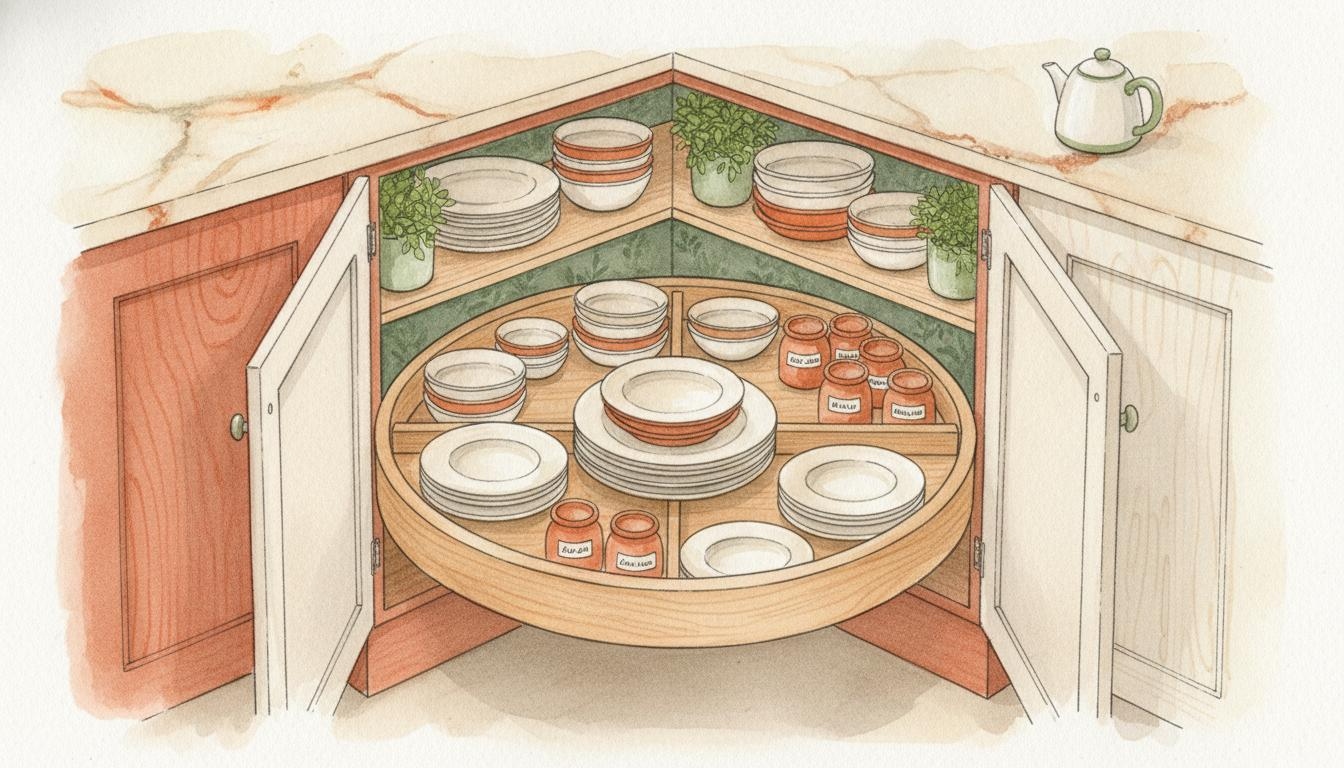
Every kitchen has at least one corner, and almost every homeowner has stared into that awkward void wondering why the space feels so useless. The typical corner kitchen cabinet swallows items whole — that spare roasting pan you need twice a year, the blender base you forgot you owned, the serving platter that somehow migrated to the back and never returned. Estimates vary, but a standard blind corner can waste 30 to 50 percent of its usable volume simply because you cannot reach it.
This guide walks through the five main corner kitchen cabinet solutions on the market today. We cover how each one works, what it costs, and who it suits best. If you are pricing a full remodel, our kitchen cabinet cost breakdown puts these corner units in context against your total cabinetry budget.
Why Corner Cabinets Fail (and What Good Design Changes)
The root problem is geometry. Two cabinet runs meet at 90 degrees, creating a deep wedge of space. In a basic blind corner, the opening reaches only partway into that wedge. Anything pushed past the opening essentially disappears.
Good corner cabinet design does one of two things: it brings the storage out to you, or it moves the entry point so you can walk the storage. The solutions below fall into one of those camps. Picking the right one depends on your cabinet layout, your budget, and how you actually cook.
The Five Types of Corner Kitchen Cabinets
Blind Corner Cabinet ($150–$400)
A blind corner is the simplest and cheapest option — and the reason most homeowners hate their kitchens. One cabinet run extends partway into the corner, leaving a hidden section behind it that you access from the adjacent run. The footprint is straightforward for builders, which is why you see it in so many production homes.
How it fixes the dead zone: On its own, it does not. A bare blind corner is a storage graveyard. The fix comes from aftermarket pull-out hardware: half-moon shelves, swing-out trays, or pull-and-slide mechanisms that glide out when you open the door. Hardware adds $200–$600 to the base cabinet cost, so a fully functional blind corner often lands in the $400–$1,000 range all-in.
Best for: Tight budgets where you plan to add hardware later, or layouts where plumbing or ductwork already occupies part of the corner.
Drawback: Even with hardware, access is indirect. You open one door, then deploy the mechanism. If you are racing to grab a colander while pasta boils, it feels like one step too many.
Lazy Susan Cabinet ($200–$800)
The Lazy Susan rotates. A circular or kidney-shaped tray — or a pair of trays — sits on a central pivot inside the corner cabinet. You spin the tray and the item comes to you. Single-tray models occupy the lower half of the cabinet; double-tray models stack two rotating levels.
How it fixes the dead zone: Rotation replaces reach. Instead of stretching into the void, you spin the contents into the doorway. Full-circle trays access nearly the entire corner footprint. Kidney-shaped trays leave a small dead spot in the center but glide more smoothly around plumbing.
Best for: Pantries and base cabinets where you store lots of medium-size items: mixing bowls, storage containers, canned goods. The motion is intuitive for households with kids or anyone who dislikes bending to search shelves.
Drawback: The central pole and rotating mechanism consume space. Large items — a stand mixer, a big Dutch oven — may not fit. Trays can also sag over time if loaded beyond their weight rating, typically 50–75 pounds per shelf.
Magic Corner Pull-Out ($400–$1,200)
A magic corner is a two-stage pull-out system. When you open the corner cabinet door, the front tray slides outward. Then you pull a handle and a second tray, positioned deeper in the corner, glides out from the side. Everything comes to you in sequence — nothing stays buried.
How it fixes the dead zone: It eliminates the dead zone almost entirely. The mechanism uses the full depth and width of the corner, including the blind area that other systems leave behind. Brands like Rev-A-Shelf, Häfele, and Blum dominate this category, and their hardware quality varies. Blum’s Legrabox system runs at the premium end but slides with minimal resistance. Rev-A-Shelf offers more budget-friendly models that still outperform basic blind-corner hardware. We may earn a commission if you purchase through these links, at no extra cost to you.
Best for: Serious cooks who use the corner daily and want direct access to pots, pans, or small appliances. Also ideal if you are already investing in high-quality cabinetry and want hardware to match.
Drawback: Cost. A magic corner unit can cost as much as a standard base cabinet plus its hardware combined. Installation also requires precise alignment; if the slides are off by even an eighth of an inch, the mechanism binds.
Diagonal Corner Cabinet ($300–$900)
Instead of hiding the corner, a diagonal cabinet claims it. The front face sits at a 45-degree angle across the corner, creating a broad, accessible opening. You see these most often as wall cabinets above sinks or as base cabinets with a single large door.
How it fixes the dead zone: The diagonal face turns the corner into a conventional cabinet. There is no blind cavity because the opening spans the full width. Inside, you typically find fixed shelves; some homeowners add a Lazy Susan or pull-out trays for even better access.
Best for: Wall-cabinet corners, especially above cooktops or prep areas where a wide opening is more valuable than deep storage. Diagonal bases also work well in open kitchens where the angled face adds visual interest.
Drawback: The diagonal front disrupts the straight line of your cabinet run. Some homeowners find the angled doors harder to keep aligned. Interior volume is also slightly lower than a same-footprint blind corner because the angled face cuts off the rear corners.
Corner Drawer Cabinet ($400–$1,200)
A corner drawer system replaces the conventional door-and-shelf setup with a stack of shaped drawers that nest into the corner. The front drawer face is typically L-shaped or trapezoidal; when you pull it out, the full drawer box follows, bringing everything into the open.
How it fixes the dead zone: Like the magic corner, it brings the storage to you. The difference is the form factor. Drawers divide contents vertically, which some people find easier to organize than a single deep cavity. If you already prefer drawer bases over door bases, a corner drawer feels like a natural extension.
Best for: Fans of drawer-based kitchens — the subject of our full kitchen cabinet drawer guide — who want consistent hardware and styling across the whole room.
Drawback: Corner drawers are the most expensive option per cubic foot of storage. The custom-shaped boxes require precise manufacturing, and not all cabinet lines offer them. Soft-close drawer slides add another $30–$60 per drawer.
Pull-Out Hardware Brands Worth Knowing
The hardware inside a corner cabinet matters as much as the box itself. Three brands come up repeatedly in professional kitchens and high-end remodels:
Rev-A-Shelf offers the widest range of corner solutions, from basic kidney-shaped Lazy Susans to full magic corner systems. Prices run from $100 for a simple rotating tray to $800 for a complete pull-out ensemble. Availability is broad — you can find Rev-A-Shelf products at most cabinet supply houses and online retailers.
Häfele leans toward the premium segment. Their corner pull-out systems use heavier-gauge steel and smoother slide mechanisms. Expect to pay 30–50 percent more than Rev-A-Shelf for comparable configurations. Häfele also offers more sizing flexibility for European frameless cabinets.
Blum is best known for drawer slide and hinge systems, but their Legrabox and Tandembox corner hardware integrates seamlessly with their broader ecosystem. If your kitchen already uses Blum soft-close drawers, staying in the same family keeps the feel consistent. We may earn a commission if you purchase through these links, at no extra cost to you.
When comparing brands, check the weight rating, the slide extension length, and whether the mechanism requires a specific minimum cabinet opening. A magic corner designed for a 36-inch cabinet will not fit a 33-inch opening without modification.
Installation: Face Frame vs. Frameless Matters
Your cabinet construction type dictates what hardware fits and how complex the install becomes.
Face-frame cabinets have a hardwood frame attached to the front of the box. The frame narrows the opening — typically by 1.5 inches on each side — and can interfere with full-extension slides. Most corner pull-out hardware requires a frameless opening or needs spacers and adapters to clear the frame. If you are retrofitting a face-frame kitchen, budget an extra hour or two per cabinet for fitting.
Frameless (European-style) cabinets offer the full box width as an opening. Hardware installs directly to the cabinet sides, and full-extension slides operate without interference. Frameless construction also makes diagonal and corner drawer cabinets easier to build because there is no frame to work around.
If you are ordering new cabinets, specify your hardware choice before the boxes are built. Some manufacturers pre-drill for specific slide systems, which saves labor and reduces error. For a broader look at how cabinet construction affects your total budget, see our kitchen cabinet cost guide.
Corner Cabinet Comparison Table
| Type | Cost Range | Access Rating (1–5) | Best For |
|---|---|---|---|
| Blind Corner | $150–$400 (cabinet only) | 2/5 | Tight budgets; retrofits where plumbing/ductwork blocks the corner |
| Lazy Susan | $200–$800 | 4/5 | Medium-sized items; households that want simple rotation |
| Magic Corner Pull-Out | $400–$1,200 | 5/5 | Daily-use items; serious cooks who want full access |
| Diagonal Corner | $300–$900 | 3/5 | Wall cabinets; open kitchens where the angled face looks intentional |
| Corner Drawer | $400–$1,200 | 4/5 | Drawer-based kitchens; those who prefer divided vertical storage |
Access ratings assume hardware-integrated systems where applicable. A bare blind corner without pull-outs rates 1/5.
How to Choose the Right Corner Kitchen Cabinet for Your Remodel
Start with usage, not aesthetics. Ask yourself what you will actually store in that corner. Pots and pans every day? A magic corner or corner drawer justifies the cost. Holiday servingware you touch three times a year? A Lazy Susan or even a basic blind corner with a half-moon shelf is fine.
Next, consider the adjacent cabinets. If one run hosts your cooktop, the corner may need to accommodate vent ducting, which limits your options. If the corner sits next to a dishwasher, make sure the open door does not block the corner cabinet drawer or pull-out path.
Finally, match the hardware quality to the rest of the kitchen. A $1,200 magic corner in a kitchen with $80-per-box big-box cabinets is overkill. Conversely, cheap plastic trays in a custom walnut kitchen will feel out of place. If you are also planning a pantry, our pantry cabinet cost and storage guide explains how corner storage and pantry storage work together to keep your kitchen functional.
Cost Reality Check: What You Will Actually Pay
The price ranges above are for the cabinet and basic hardware only. Installation labor runs $50–$150 per cabinet depending on your market and whether you are retrofitting or installing new. If your contractor needs to relocate plumbing, electrical, or ductwork in the corner, add $200–$800.
Premium hardware — soft-close slides, solid-wood trays, and full-extension systems — adds 30–60 percent to the base hardware cost. Custom-sized corner drawers or specialty laminate interiors push the total even higher.
All cost figures in this guide reflect mid-2026 US market ranges. Prices vary significantly by region. Labor rates in the Northeast and West Coast run 20–40 percent higher than in the South and Midwest. Always get at least two local quotes before committing.