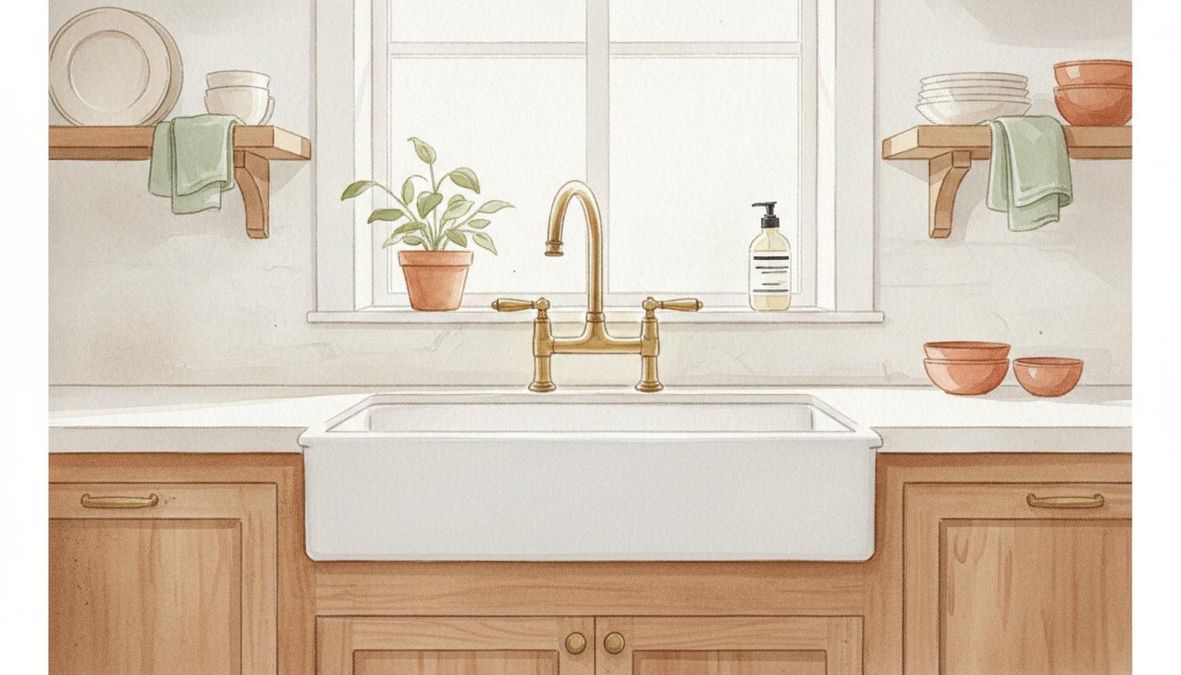
Pair the right sink with the right base cabinet. Here’s your complete guide to sink-base cabinets — sizes (30”, 33”, 36”), materials, mount types, and cost.
You can spend weeks choosing cabinet door styles and countertop colors, then treat the sink as an afterthought. That’s a mistake. The kitchen sink in cabinet pairing determines how your workspace functions every single day, and getting it wrong means either a cramped prep area or a cabinet that can’t support the bowl you bought. This guide covers standard sink-base cabinet sizes, how sink mount types affect cabinet construction, material costs, and what you’ll pay for a complete installed setup.
Sink-Base Cabinet Sizes: What Actually Fits
Sink-base cabinets are built without a top drawer and with the door(s) cut down to accommodate the sink bowl and plumbing. The width of that cabinet determines nearly everything else.
36-Inch Sink Base (Most Common for Single Bowl)
The 36-inch sink base is the default in most layouts. It fits single-bowl sinks up to roughly 33 inches wide and leaves a few inches of cabinet frame on each side for structural support. If you’re planning a large single bowl — popular with home cooks who bake or handle big sheet pans — this is the size you want. Most kitchen cabinet cost estimates assume a 36-inch sink base as the standard.
33-Inch Sink Base (The Compromise)
A 33-inch base works with sinks up to about 30 inches wide. You’ll see this in smaller kitchens, galley layouts, or where space between cabinets is tight. It’s functional but limits your sink options. If you’re trying to squeeze a workstation sink with built-in ledges into a 33-inch base, check the specs carefully — many won’t fit.
30-Inch Sink Base (Minimum Viable)
Thirty inches is as narrow as you should go for a full kitchen. It accommodates sinks up to about 27 inches wide. This size appears in compact kitchens, secondary prep areas, and some apartment layouts. You lose workspace inside the bowl, and finding accessories that fit can be harder. If your kitchen is this tight, consider whether a kitchen cabinet drawer guide approach for nearby storage becomes even more critical, since the sink base itself offers no drawer space.
24-Inch Sink Base (Bar and Utility)
Twenty-four-inch bases are not for main kitchen sinks in most homes. They’re meant for wet bars, laundry rooms, or secondary prep sinks. The bowl is small, and the plumbing takes up a disproportionate amount of the cabinet interior.
42-Inch and Wider (Double-Bowl Territory)
Move up to 42 inches or more and you can fit a true double-bowl sink with two equally sized basins. Some homeowners love the separation — wash on one side, rinse on the other. Others find the divider wastes space. If you go this wide, make sure your countertop fabricator is involved early; the cutout for a double-bowl undermount is substantial and affects slab integrity, as covered in our granite vs quartz countertop comparison.
Sink Mount Types and Cabinet Requirements
How the sink attaches to the countertop — and by extension, how it interacts with the cabinet below — changes both installation complexity and long-term usability.
Top-Mount / Drop-In Sinks
A drop-in sink has a rim that sits on top of the counter, with the bowl dropping through a cutout. The cabinet below needs standard sink-base construction — no top drawer, reinforced top rail — but nothing custom. This is the easiest and cheapest installation. It works with laminate, solid surface, and stone countertops.
The downside is the raised rim. It creates a lip that traps crumbs and makes wiping water from the counter into the sink harder. If you’re replacing a sink without replacing countertops, drop-in is often your only practical option unless the existing cutout is large enough to accommodate an undermount retrofit.
Undermount Sinks
Undermount sinks attach to the underside of the countertop. The cabinet needs a finished sink base, but the critical requirement is the countertop material and fabrication. Stone, quartz, and solid-surface counters handle undermounts well. Laminate generally does not — the exposed edge of the substrate is vulnerable to moisture damage.
The fabricator will cut the countertop opening precisely to the sink template, then polish the exposed edge. This adds $200–$500 to countertop costs versus a drop-in installation. Undermounts make counter cleanup easier since there’s no rim, but they require clips or adhesive brackets installed inside the cabinet. If your sink base is shallow or has internal supports in the way, access can be tight.
Farmhouse / Apron-Front Sinks
Farmhouse sinks are the most demanding on cabinet construction. The front of the sink base cabinet must be cut down or custom-built to expose the apron — the forward-facing panel of the sink itself. Standard cabinets cannot accept a farmhouse sink without modification.
If you’re buying new cabinets, order a farmhouse sink base designed for your specific sink model. If you’re retrofitting, a cabinet maker can modify an existing sink base, but the cut must be precise and the remaining structure needs reinforcement. The apron-front sink also extends forward slightly, affecting countertop depth and edge treatment.
Choose the farmhouse sink before cabinets are built or ordered, and confirm the exact apron height, width, and projection with your cabinet supplier. This is not a last-minute swap.
Sink Material Options and What They Cost
Stainless Steel (16–18 Gauge)
Stainless steel dominates the market for good reason. It’s affordable, resists heat and stains, and comes in enough shapes and sizes to fit nearly any cabinet. Gauge matters: 16-gauge steel is thicker and quieter than 18-gauge. Cheaper sinks at 20- or 22-gauge dent easily and sound like a drum when water hits them.
A quality 16- or 18-gauge stainless single-bowl sink runs $200–$600. Undermount versions cost slightly more than drop-in. Higher-end brands with sound-dampening pads reach $800–$1,200.
Fireclay
Fireclay sinks are ceramic baked at extremely high temperatures. The surface is hard, non-porous, and resistant to scratches and acids. The aesthetic is clean and traditional — especially popular in farmhouse styles. Fireclay is heavy, which means the cabinet base and any supports must be rated for the load.
Single-bowl fireclay farmhouse sinks range from $600–$1,500. White is standard; custom colors from premium manufacturers run higher. The material is brittle — dropping a heavy cast-iron pan from height can crack it.
Cast Iron Enamel
Cast iron coated in porcelain enamel offers a glossy, durable surface and excellent sound dampening. These sinks have been around for generations. They’re even heavier than fireclay, so cabinet support is critical. The enamel can chip if struck hard, exposing the dark iron underneath.
Expect $400–$1,000 for a single-bowl cast iron sink. Double-bowl versions and unusual colors push toward the top of that range. Kohler and American Standard are the dominant brands here.
Granite Composite
Granite composite — typically 80% quartz sand and 20% resin — is extremely durable. It resists scratches, heat up to roughly 500°F, and stains better than most materials. The matte finish and neutral colors (black, gray, brown, white) suit modern kitchens.
Single-bowl granite composite sinks run $300–$700. Undermount is the most common configuration. The material is heavy but generally lighter than fireclay or cast iron, so most standard sink bases handle it without extra reinforcement.
Copper
Copper sinks are niche but distinctive. They develop a patina over time — warm and varied, though not everyone likes the change. Copper has natural antimicrobial properties. The downside is maintenance: acidic foods and harsh cleaners can strip the finish.
Hand-hammered copper farmhouse sinks start around $800 and climb past $2,500 for large or custom designs. If you want the look of copper without the price, some stainless sinks come in copper-tone PVD finishes for roughly half the cost.
Faucet Hole Drilling and Sink Choice
Your sink or countertop determines where and how faucet holes are placed. Drop-in sinks often come with pre-punched knockouts for one to four holes — faucet, side spray, soap dispenser, air gap. Undermount and farmhouse sinks typically have no deck at all, which means faucet holes are drilled directly into the countertop behind the sink.
If you’re choosing a sink with an integrated faucet deck, count the holes you need before buying. Switching from a three-hole faucet to a single-hole later means exposed openings. If your sink has no deck and your countertop is already drilled, make sure the hole spacing matches your intended faucet — or plan to redrill.
Wall-mounted faucets are another option, especially with farmhouse sinks. They free up deck space and look distinctive, but require plumbing in the wall rather than the cabinet. This adds cost and complexity.
Total Installed Cost: Realistic Budget Ranges
These ranges include the sink, faucet, necessary cabinet modifications, countertop cutout or replacement, and professional installation. They assume mid-range materials and standard US labor markets.
| Project Type | Total Installed Cost | What’s Included |
|---|---|---|
| DIY drop-in replacement | $200–$500 | Sink, basic faucet, plumber connect |
| Undermount with new countertop cutout | $600–$1,500 | Sink, faucet, countertop fabrication, install |
| Farmhouse sink, new install | $1,500–$4,000+ | Custom sink-base cabinet, sink, faucet, countertop work, install |
| Full sink-base cabinet replacement | $2,000–$5,500 | New cabinet, sink, faucet, counter modification, plumbing, install |
The DIY drop-in assumes you’re comfortable disconnecting and reconnecting plumbing and that the existing cabinet and countertop are in good shape. If your counter is stone and you need a new cutout for an undermount, add the fabricator’s fee — typically $300–$800 depending on your market. Farmhouse installs vary the most because cabinet modification ranges from a simple front-panel cut to a complete custom build.
Sink Material and Mount Type Comparison
| Material / Mount | Installed Cost | Pros | Cons | Best For |
|---|---|---|---|---|
| Stainless steel, drop-in | $250–$700 | Affordable, easy to replace, works with any counter | Rim traps debris, less refined look | Budget remodels, rental properties, laminate counters |
| Stainless steel, undermount | $500–$1,200 | Clean counter lines, easy wipe-in, modern look | Requires solid-surface counter, harder to replace | Most stone or quartz countertop installs |
| Fireclay, farmhouse | $1,200–$3,000 | Beautiful finish, extremely hard surface, classic aesthetic | Heavy, can crack on impact, requires custom cabinet | Traditional and transitional kitchens |
| Cast iron enamel, drop-in | $500–$1,100 | Glossy finish, very quiet, proven longevity | Very heavy, enamel can chip, limited colors | Homeowners who want a familiar, durable sink |
| Granite composite, undermount | $500–$1,200 | Scratch-resistant, heat-tolerant, modern matte look | Limited color range, can dull knives if used as cutting surface | Busy cooks, modern kitchen designs |
| Copper, farmhouse | $1,500–$4,000+ | Unique appearance, antimicrobial, develops character patina | Expensive, reacts to acids, develops patina (desired or not) | Statement kitchens, specific design visions |
The “installed cost” column includes the sink, a mid-range faucet, and typical labor for that mount type. Your total may land above or below depending on regional labor rates, countertop material, and whether cabinet modification is needed.
Installing a Kitchen Sink in Cabinet: Key Checks
Measure Your Existing Cabinet First
Measure the interior width of the sink base at the top opening — not the door width, not the exterior. The sink must fit between the cabinet sides with a small margin for clips and sealant. Also check front-to-back depth; deep farmhouse sinks can interfere with drawer glides in shallow bases.
Confirm Countertop Overhang
Undermount sinks need enough countertop overhang around the cutout for mounting clips or epoxy. If your counter has minimal overhang into the sink-base opening — common in prefab or laminate installs — undermount may not be structurally viable. A fabricator can assess this in minutes.
Think About Workstation Sinks
Workstation sinks include built-in ledges for cutting boards, colanders, and drying racks. They’re useful but add cost ($400–$1,500+) and need a wide enough sink base for the full track system. Confirm the ledge hardware fits your cabinet depth and won’t collide with window sills above.
Affiliate Disclosure
This guide contains links to sink and faucet retailers. We may earn a commission if you purchase through these links, at no extra cost to you.
Regional Cost Note
Prices in this guide reflect mid-range US markets as of mid-2026. Labor in major metro areas — New York, San Francisco, Boston — can run 30–50% higher. Rural areas may have lower labor costs but limited fabricator availability, which can extend timelines. Sink and faucet prices from national retailers are fairly consistent nationwide, but shipping heavy farmhouse sinks adds cost. For any project involving cabinet modification or countertop work, get at least two local quotes before committing.