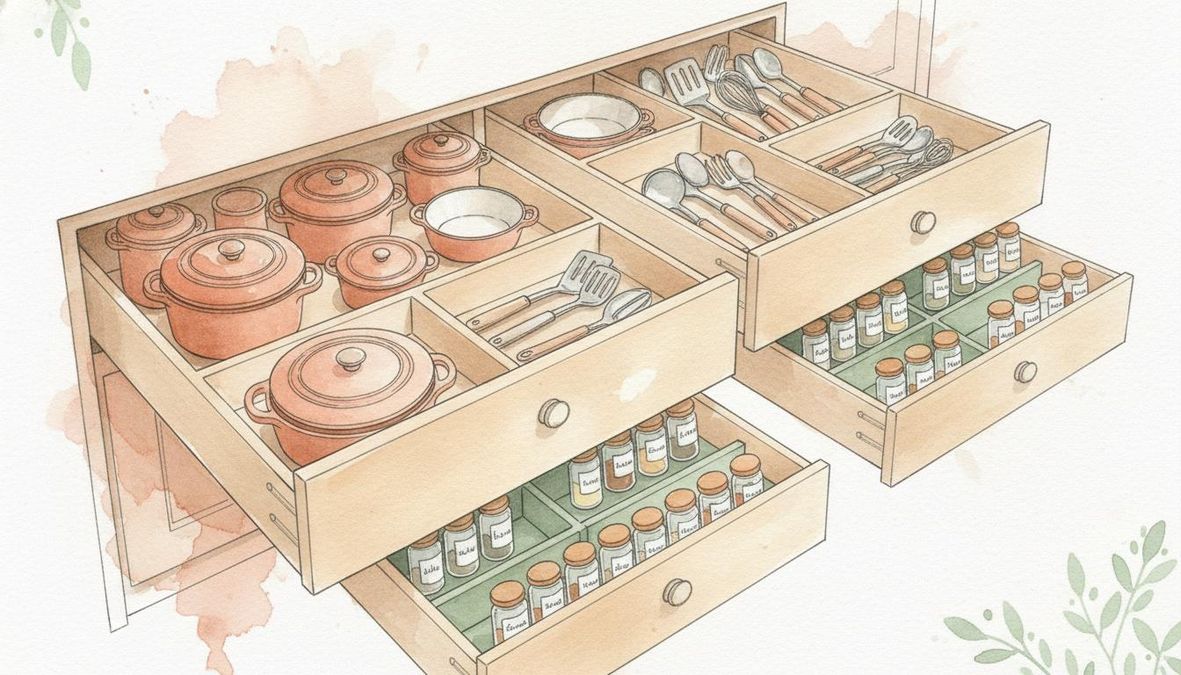
If you’re choosing cabinets for a remodel, kitchen cabinet drawer configurations deserve more attention than they typically get. Most homeowners focus on door style, finish color, and overall layout — then accept whatever drawer arrangement comes standard. That’s a mistake. Drawers outperform doors-with-shelves for daily use by nearly every measure: accessibility, storage density, and ergonomic comfort. A drawer glides out toward you, bringing everything into view at waist height. A cabinet door swings open and leaves you reaching into a dark box, crouching to see what’s in back.
European kitchens have favored drawers for years; American manufacturers caught up as homeowners demanded better function. Today, every major cabinet line offers extensive drawer-base options. The question isn’t whether to include drawers, but which types and how many. For context on how drawer cabinets fit into your total cabinetry budget, see our full kitchen cabinet cost guide.
This guide breaks down the main drawer-cabinet types, what each costs, how drawer-box construction affects longevity, and the hardware decisions that separate a drawer you’ll love from one that jams after two years. For related reading on awkward storage zones, see our corner kitchen cabinet guide.
Types of Kitchen Cabinet Drawers
The configuration — how many drawers, how deep, what interior fittings — determines what you can store and how easily you access it.
3-Drawer Base Cabinet
The workhorse of the modern kitchen. A three-drawer base sits below a counter run and offers three stacked drawers: a shallow top drawer (4–6 inches) for utensils and cutlery; a medium middle drawer (8–10 inches) for dishes or mixing bowls; and a deep bottom drawer (12+ inches) for pots, pans, or small appliances.
The graduated heights matter. The shallow top keeps silverware from sliding around. The deep bottom swallows a stand mixer or sheet pans without wasted headroom. Most semi-custom lines let you specify interior upgrades — peg systems for dishes, tiered cutlery trays, or knife blocks.
Cost for a 3-drawer base: $350–$800 stock, $600–$1,400 semi-custom, $1,200–$2,500 custom. Widths range from 18 to 36 inches; the 24-inch and 30-inch versions offer the best storage-to-cost ratio.
2-Drawer Pots-and-Pans Base
Two deep, equal-height drawers — usually 12–14 inches each — designed for cookware. A full sheet pan slides in flat. A Dutch oven sits without tilting. Stacked skillets separate with an interior organizer.
The key specification is interior height. Measure your tallest pot with the lid on, then add an inch. Nothing is more frustrating than a drawer that almost fits your roasting pan. Specify full-extension slides (more on hardware below); standard 3/4-extension slides leave the back few inches inaccessible.
Cost: $400–$900 stock, $700–$1,500 semi-custom, $1,400–$2,800 custom.
Deep Single Drawer
One oversized drawer, typically 24–36 inches wide and 12–14 inches deep, used for trash and recycling, a baking center, or bulk storage for large items. Some homeowners place one below a cooktop to store frequently used pots — pull, grab, cook.
The single-drawer format shines with specialized interiors: a built-in trash system, a lift-platform for a heavy mixer, or a peg-board base that keeps dishes from shifting. These inserts add $100–$400 but transform generic space into purpose-built storage.
Cost: $300–$700 stock, $550–$1,200 semi-custom, $1,100–$2,200 custom.
Spice and Utensil Pull-Out Drawers
Narrow drawer cabinets — 6 to 12 inches wide — installed beside the range for spice storage, or near prep areas for utensil organization. For spices, the drawer format wins: every jar visible at a glance. A well-designed spice drawer has a tiered interior that angles labels upward so you read them from above.
For utensils, a divided shallow drawer with compartments for spatulas, ladles, and tongs keeps tools organized without a countertop crock. Don’t under-size: a 6-inch spice drawer fills fast. A 9-inch or 12-inch width is usually worth the upgrade.
Cost: $200–$500 stock, $350–$800 semi-custom, $700–$1,400 custom.
Peg-Organizer Drawer
A drawer with a movable peg system — a plywood base with drilled holes and wooden dowels — that lets you customize compartments for dishes, platters, or pots. The pegs rearrange without tools, so you reconfigure as your collection changes. These started as high-end custom features but are now available from most semi-custom lines and even some stock manufacturers.
Cost: $50–$200 for the peg insert, added to the base drawer cabinet cost.
Kitchen Cabinet Drawer Box Construction: Particle Board vs. Plywood vs. Solid Wood
The box — the four sides and bottom that form the drawer — determines how long your drawer lasts under load. Three construction grades exist, and the cost difference between cheapest and best is significant.
Particle Board with Stapled Joints
Particle board is made from compressed wood fibers and resin. It’s flat, consistent, and cheap. The problem is moisture: when a dishwasher leaks, particle board swells and loses integrity. Stapled joints also pull apart over time under weight.
Modern melamine-coated particle board resists minor moisture well and works for light-duty drawers — top utensil drawers, spice pull-outs. But specify plywood or solid wood for your pots-and-pans drawers at minimum.
Cost: Standard on stock cabinets; upgrading to plywood adds $15–$30 per drawer on semi-custom lines.
Plywood with Dado Joints
Plywood — multiple thin layers of wood veneer glued together — resists warping and moisture far better than particle board. Dado joints (grooved connections) create a stronger mechanical bond than staples. Most quality semi-custom cabinets use plywood drawer boxes as standard.
Cost: Standard on mid-to-upper semi-custom lines; roughly $15–$30 per drawer to upgrade from particle board on budget lines.
Solid Wood with Dovetail Joints
Dovetail joints — interlocking wedge-shaped cuts — are the strongest joint in woodworking. Combined with solid hardwood sides (maple, birch, or beech), a dovetailed drawer box is built to last decades. Custom cabinetmakers consider this baseline; semi-custom lines offer it as an upgrade.
Cost: $25–$50 per drawer as an upgrade on semi-custom; standard on most custom cabinets.
| Construction Grade | Joint Type | Weight Capacity | Moisture Resistance | Cost per Drawer |
|---|---|---|---|---|
| Particle board | Stapled/doweled | Light to medium | Poor | Standard (base) |
| Plywood | Dado/rabbet | Medium to heavy | Good | +$15–$30 upgrade |
| Solid wood dovetail | Dovetail | Heavy | Excellent | +$25–$50 upgrade |
Drawer Slide Hardware: The Make-or-Break Detail
The slide mechanism determines how your drawer feels every time you use it. Cheap slides bind and sag. Quality slides glide silently and hold alignment for decades.
Undermount vs. Side-Mount
Undermount slides attach to the bottom edges of the drawer and are hidden from view when open. They typically offer full extension and soft-close as standard. Undermounts require precise drawer-box tolerances, which is why they’re standard on semi-custom and custom cabinets but rarely on budget stock.
Side-mount slides attach to the drawer sides and are visible when open. They cost less and perform well, but the exposed hardware isn’t as clean visually. For a kitchen you’ll use daily, undermount slides are worth the upgrade.
Slide Brands and Quality Tiers
Blum Tandem is the industry benchmark. Austrian-made undermount slides with integrated soft-close, full extension, and a 100-pound+ load rating. Limited lifetime warranty. If a drawer glides like butter, it’s probably Blum. Cost: $25–$45 per pair.
Hettich matches Blum in quality with slightly less US name recognition. Their Quadro undermount slides are excellent and sometimes priced lower. Cost: $20–$40 per pair.
KV (Knape & Vogt) offers solid mid-tier slides — the kind found on mid-range stock and budget semi-custom cabinets. Cost: $12–$25 per pair.
No-name imports run under $8 per pair. They work when new but wear quickly and sag under weight. Expect to replace them within 5–8 years.
Lifetime Ratings
Quality slides test to 50,000–80,000 open-close cycles. At 20 cycles per day, that’s 7–11 years before meaningful wear. Cheap slides may rate at 10,000 cycles — less than two years of kitchen use.
Drawer Pulls and Knobs: Cost Ranges
Hardware takes the brunt of daily interaction: greasy hands, rushed grabs, thousands of repetitions. Buy pieces that feel good and won’t show wear.
| Hardware Type | Price Range (Each) | Characteristics |
|---|---|---|
| Basic knobs | $2 – $5 | Zinc or aluminum. Functional but plain. |
| Mid-range pulls | $6 – $15 | Brushed nickel, matte black. Better finishes and ergonomics. |
| Premium hardware | $16 – $30+ | Solid brass, leather-wrapped, architectural designs. |
A typical kitchen has 25–40 pulls. At $8 each, that’s $200–$320 total. At $22 each, it’s $550–$880. Unlike cabinet construction, hardware is easy to upgrade later — a 20-minute swap per piece.
Sizing tip: A pull should be roughly one-third the drawer width. For drawers over 24 inches wide, consider two smaller pulls side by side instead of one long bar.
We may earn a commission if you purchase through these links, at no extra cost to you.
Drawer Cabinet Comparison
| Drawer Cabinet Type | Cost Range (Semi-Custom) | Best Use | Capacity |
|---|---|---|---|
| 3-drawer base | $600 – $1,400 | General storage, mixed items, daily dishes | High — graduated heights |
| 2-drawer pots-and-pans | $700 – $1,500 | Cookware, sheet pans, large items | Very high — deep, uniform |
| Deep single drawer | $550 – $1,200 | Trash, baking center, bulky appliances | High — one oversized compartment |
| Spice/utensil pull-out | $350 – $800 | Spices near range, utensils near prep | Low to medium — narrow |
| Peg-organizer drawer | +$50 – $200 insert | Dishes, serving pieces | Medium — pegs reduce raw capacity |
Most kitchens benefit from at least one 3-drawer base and one 2-drawer pots-and-pans cabinet. Add a spice pull-out beside the range and a peg drawer near the dishwasher. The deep single drawer works anywhere you have a storage challenge that doesn’t fit standard formats.
Where to Put Drawer Cabinets
Store items where you use them. Pots go within one step of the range. Dishes go between the dishwasher and sink. Spices go beside the range, not across the kitchen. Default layouts from big-box retailers often ignore this workflow.
Prioritize base cabinets for drawers, wall cabinets for doors. Wall-mounted drawers exist but they’re expensive and hold less. The real estate below your counters is where drawers transform daily use.
Don’t forget the sink cabinet. Some semi-custom lines offer U-shaped drawer systems that wrap around plumbing, reclaiming lost space. For more on sink-cabinet integration, see our kitchen sink and cabinet guide.
FAQ
Are drawer cabinets more expensive than door cabinets?
Yes — typically 15–30% more for the same width. The slides, box construction, and precise fitting add cost. But the usability gain is disproportionate to the price. Most homeowners who switch to drawer-heavy kitchens report higher satisfaction than any other cabinet upgrade.
How many drawer cabinets should my kitchen have?
For a typical 10×10 kitchen, aim for 4–6 drawer-base cabinets out of 15–20 total openings. Usually that means two 3-drawer bases, one 2-drawer pots-and-pans, one spice pull-out, and one or two deep single drawers.
Can I add drawers to my existing door cabinets?
Yes. Companies like Rev-A-Shelf install pull-out drawers inside existing door cabinets for $150–$400 per drawer. You lose some interior space since the drawer sits inside the cabinet box, but it’s a solid upgrade if a full remodel isn’t in the budget.
What’s the weight limit for a kitchen drawer?
Quality undermount slides (Blum, Hettich) rate at 100–130 pounds. Side-mount slides range from 75 to 100 pounds. Most household kitchen drawers stay well under 50 pounds loaded. Only a drawer full of cast iron approaches the limit.
Do soft-close drawers wear out?
The hydraulic damper can degrade over 10–15 years. On quality slides, it’s a replaceable $5–$10 part. On cheap slides, the whole assembly needs replacement. This is why premium slides are worth the upfront cost.
What’s the best drawer configuration for a small kitchen?
Prioritize a 3-drawer base (maximum versatility in minimal space) and a narrow spice pull-out. Skip the single deep drawer unless you have a specific use for it. In kitchens under 70 square feet, every cabinet must multitask.
Should I upgrade to dovetail drawers on a budget remodel?
Upgrade selectively. Specify dovetail for your two heaviest-use drawers — pots-and-pans and dishes. Accept plywood for light-use drawers like spice and utensil pull-outs. This hybrid approach gets durability where it matters without blowing the budget.
What’s the difference between full-extension and 3/4-extension slides?
Full-extension slides expose 100% of drawer contents. Three-quarter extension leaves the back 20–25% inside the cabinet. For kitchen use, full-extension is non-negotiable — you need to reach the back of a pots-and-pans drawer. Don’t accept 3/4-extension on any drawer storing items larger than a silverware tray.
Prices vary by region. Costs in the Northeast and West Coast typically run 15–25% higher than the national averages shown. We recommend getting at least three local quotes before making final cabinet selections.