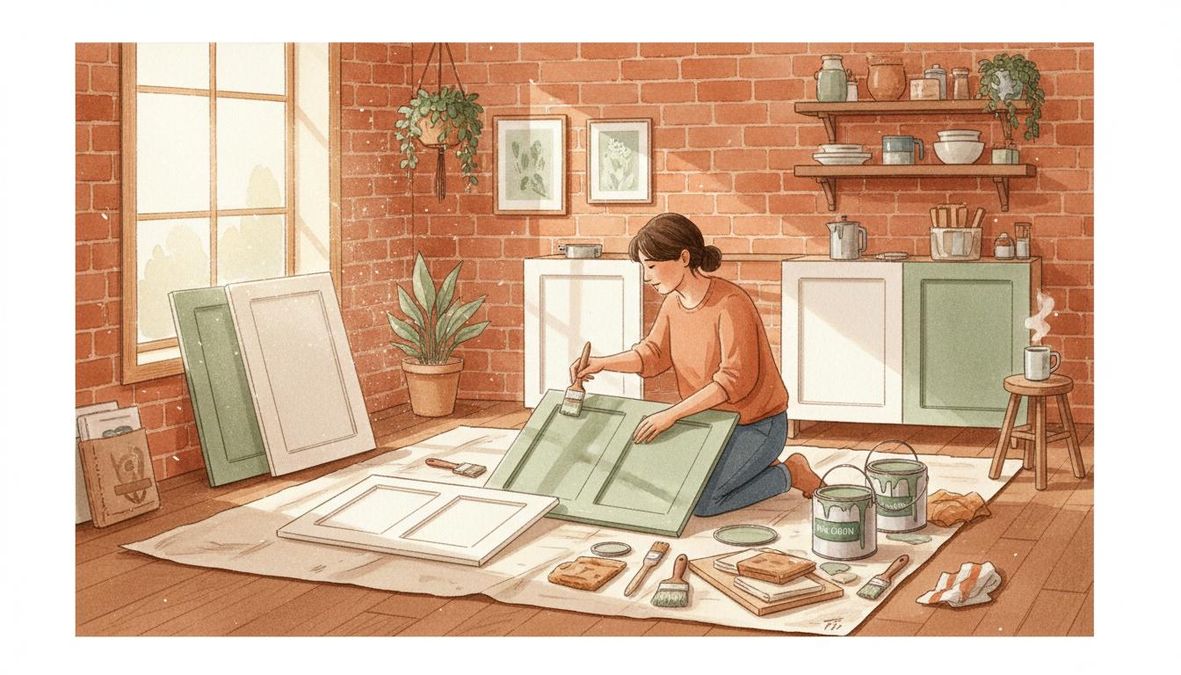
Painting kitchen cabinets DIY costs $200–$600 and a weekend; hiring a pro runs $1,500–$5,000. Here’s the full step-by-step process and when to pay someone.
Painting your kitchen cabinets is the single biggest bang-for-buck upgrade you can make. If you’re researching how to paint kitchen cabinets, the good news is this: almost anyone can get professional-looking results with patience, the right materials, and a clean workspace. Shortcut the prep, though, and you’ll see every mistake every morning for the next five years.
This guide covers the full DIY process, what it costs to do it yourself versus hiring a pro, how to choose the right paint, and the mistakes that trip up first-timers. Costs below are based on an average U.S. kitchen with 20–30 cabinet doors and 5–10 drawer fronts, but prices vary by region — always get local quotes for pro work.
DIY vs. Hiring a Pro: What It Costs
The cost gap between DIY and professional cabinet painting is dramatic.
| Cost Factor | DIY | Professional |
|---|---|---|
| Paint & primer | $80–$200 | Included in quote |
| Brushes, rollers, tape | $30–$80 | Included |
| Sprayer rental (optional) | $50–$100/day | Included |
| TSP/degreaser, sandpaper | $20–$50 | Included |
| Drop cloths, misc. | $20–$70 | Included |
| Labor | Your weekend | $1,000–$4,000 |
| Total cost | $200–$600 | $1,500–$5,000 |
DIY range: $200–$600 in materials for a typical kitchen. Already own brushes? Closer to $200. Renting a sprayer and buying premium paint? Closer to $600.
Pro pricing: $30–$60 per door and $50–$100 per drawer face. For 25 doors and 7 drawers, that’s roughly $1,500–$3,500. Large kitchens with intricate profiles can push toward $5,000. Some painters price by linear foot instead — $50–$100 per linear foot.
A pro brings speed, a spray booth, and experience. But if you have a garage or basement where doors can dry undisturbed for a week, DIY saves serious money.
What You’ll Need Before You Start
Gather everything before you remove the first hinge. Running to the hardware store mid-project is how cabinet doors sit half-finished for six months.
Essentials: TSP substitute or degreaser, 120-grit and 220-grit sandpaper, tack cloths, painter’s tape (FrogTape or blue), a high-quality 2–2.5 inch angled brush, foam roller with 4-inch cage, shellac-based or bonding primer, cabinet enamel paint, drop cloths, Ziploc bags for hardware, and a labeling system.
If spraying: HVLP sprayer rental ($50–$100/day), proper respirator mask, spray tent or well-ventilated garage, and paint strainers.
The 8-Step Process: How to Paint Kitchen Cabinets
Step 1: Remove Doors, Drawers, and Hardware — and Label Everything
Remove every door and drawer face. Remove hinges, knobs, and pulls. Drop hardware into labeled Ziploc bags: “Upper left,” “Island drawer 3,” and so on. Cabinet doors fit only one way, but hinges have micro-adjustments you don’t want to recreate.
Use numbered masking tape on each door and a corresponding number inside the cabinet frame. Take photos before disassembly — they help with reassembly.
Step 2: Clean Like Your Results Depend on It — Because They Do
Kitchen cabinets are coated in years of cooking grease, dust, and hand oils. Paint will not stick to grease. Use a TSP substitute (the original TSP is effective but harsh on skin and finishes) or a heavy-duty degreaser. Scrub every surface — fronts, backs, edges — with a Scotch-Brite pad and your cleaning solution. Rinse with clean water. Let everything dry completely.
This step is tedious and easy to rush. Most failed cabinet paint jobs trace back to inadequate cleaning.
Step 3: Sand or Scuff — Give the Paint Something to Bite
You don’t need to sand down to bare wood. The goal is to scuff the existing finish enough that primer can grip. Use 120-grit sandpaper on a sanding sponge or block. Work with the grain on wood doors. On laminate or thermofoil cabinets, scuff until the surface is uniformly dull — no shiny spots.
For laminate cabinets that are in good shape, you can skip aggressive sanding and use a bonding primer instead (see Step 4). But scuffing still helps.
Wipe away all dust with a tack cloth. Any dust left on the surface becomes texture in your final coat.
Step 4: Prime with Shellac-Based or Bonding Primer
Primer is non-negotiable. Cabinet enamel needs the right foundation. A shellac-based primer like Zinsser BIN is the gold standard — it sticks to glossy finishes, laminate, and stained wood, and blocks stains and tannins. The downside is strong fumes; work with ventilation and a respirator.
If shellac feels too intense, a bonding primer (Zinsser Bulls Eye 1-2-3 or Stix) works well on surfaces that aren’t heavily stained.
Apply one coat with a brush or roller. Aim for even coverage, not thickness. Let it dry per the manufacturer’s instructions — typically 45 minutes to 2 hours.
Step 5: Sand Between Coats
Once the primer is dry, lightly sand with 220-grit sandpaper. You’re not removing primer; you’re knocking down brush marks, dust nibs, and any uneven texture. Wipe with a tack cloth.
Repeat this sanding step between every coat — primer, first paint coat, and second paint coat. It’s the difference between a finish that looks sprayed and one that looks hand-painted in a hurry.
Step 6: Apply Two Coats of Cabinet Enamel
Here’s where patience separates good results from great ones. Thin coats are everything. Thick paint looks gloppy, runs, and takes forever to cure.
Apply your first coat of cabinet enamel with a brush and foam roller, or spray if you’re set up for it. Brush the edges and detailed areas first, then roll the flat panels. Work quickly to maintain a wet edge and avoid lap marks. Let the first coat dry fully — usually 4–6 hours, but check your paint can.
Sand lightly with 220-grit, tack cloth, then apply the second coat. Two thin coats always beat one thick coat.
Step 7: Let Everything Cure — Then Reattach Hardware
This is the step most people skip. Cabinet enamel feels dry to the touch in hours, but full cure — when the paint is hard enough for daily use — takes 7–14 days.
Wait at least 3–5 days before reattaching doors. Reattaching hardware too early leaves dents and fingerprints that never go away. Leave doors drying horizontally for a full week if possible.
When you reattach hardware, use a manual screwdriver for the final turns. A power drill can strip screw holes.
Step 8: Reinstall Doors and Adjust
Hang doors back on their matching frames using your labels. Most modern hinges have three adjustment screws: depth, vertical position, and horizontal position. Make small turns and check alignment against neighboring doors. The goal is even gaps and flush faces across the whole kitchen.
This takes time. Budget an hour for a full kitchen, more if you have a lot of doors.
Choosing the Right Paint: What Makes “Cabinet Enamel” Different
Regular wall paint will fail on cabinets. Cabinets need a finish that resists moisture, grease, scratches, and the impact of 1,000 dish towel swipes per year. Cabinet enamel is formulated for exactly that — a harder, more durable film than standard latex paint.
Here are three proven options:
Benjamin Moore Advance — A waterborne alkyd that levels beautifully and dries to a furniture-quality finish. $60–$80 per gallon. Widely considered the best DIY cabinet paint, though full cure takes 16–30 days.
Sherwin-Williams Emerald Urethane Trim Enamel — Combines urethane durability with water-based application ease. Excellent blocking resistance. $80–$95 per gallon. Sherwin-Williams runs 30–40% off sales regularly.
Behr Alkyd Satin Enamel — The budget option at $35–$45 per gallon at Home Depot. Performs well for the price, though it doesn’t level as smoothly as the premium options. Good for secondary spaces.
All three come in hundreds of colors. If you’re stuck choosing, our guide to kitchen cabinet color ideas covers timeless options and what works in different kitchen styles.
We may earn a commission if you purchase through these links, at no extra cost to you.
Spray vs. Roll vs. Brush: Which Method Gets the Best Result?
The application method affects both the finish quality and the time investment.
| Method | Finish Quality | Speed | Learning Curve | Best For |
|---|---|---|---|---|
| Spray (HVLP) | Smoothest, most factory-like | Fast once set up | Moderate | Confident DIYers, flat panel doors |
| Roll + brush | Very good, slight texture | Moderate | Low | Most DIYers, especially beginners |
| Brush only | Can look excellent in skilled hands | Slowest | High | Detailed inset panels, touch-ups |
Spraying produces the smoothest, most factory-like finish. An HVLP sprayer lays down an even coat with no brush or roller marks. The catch: setup is significant. You need a spray area, ventilation, a respirator, and time to learn the technique. Overspray is real — mask everything you don’t want painted.
Roll and brush is the right choice for most homeowners. Use a high-density foam roller on flat panels and an angled brush for edges and grooves. Work fast, keep a wet edge, and don’t overwork the paint.
Brush only is slowest but gives maximum control on complex door profiles. A quality angled brush and thin coats are essential.
Common Mistakes — and How to Avoid Them
After talking with dozens of painters and redoing plenty of botched DIY jobs, these are the mistakes that come up again and again:
Skipping the degreasing step. Paint adhesion fails most often because the surface wasn’t clean. TSP substitute is cheap; failed paint jobs are expensive.
Using the wrong primer. Regular drywall primer is not cabinet primer. Shellac or bonding primer is built for slick, hard surfaces. Standard primer on cabinets is like sunscreen over a rain jacket.
Applying paint too thick. Thick coats run, sag, and cure unevenly. Two thin coats always cover better than one thick one.
Not allowing full cure time. Soft paint chips, dents, and sticks to itself for weeks. Budget 7–14 days before heavy use.
Painting over damaged laminate. If thermofoil is peeling, paint won’t fix it. Address substrate problems first, or consider kitchen cabinet refacing instead. Refacing runs $4,000–$9,000. For a full cost picture of new cabinetry, see our kitchen cabinet cost guide.
Working in a dusty environment. Sawdust and pet hair love fresh paint. Clean your workspace before you start and keep it clean while doors dry.
When to Hire a Pro Instead
DIY cabinet painting saves thousands, but it’s not the right call for every situation. Consider hiring out if your cabinets are heavily damaged or warped, you don’t have a clean workspace for a week, you need the kitchen fully functional within 2–3 days, or you simply don’t have the patience for detailed prep.
A good cabinet painter brings a spray booth setup and completes most kitchens in 3–5 days. Get at least three quotes, ask to see completed jobs, and confirm they use cabinet-grade enamel — not standard trim paint.
FAQ: How to Paint Kitchen Cabinets
How long does it take to paint kitchen cabinets DIY?
Plan for 3–5 days of active work, plus 7–14 days of cure time before full use. Day 1: removal and cleaning. Day 2: sanding and priming. Day 3: first coat. Day 4: second coat. Day 5+: reassembly after partial cure. Cure time happens in the background — you can reinstall doors after 3–5 days, but go easy on them for the first two weeks.
What’s the best paint for kitchen cabinets?
For durability and a smooth finish, Benjamin Moore Advance and Sherwin-Williams Emerald Urethane are the two most trusted options among pros and experienced DIYers. Behr Alkyd Satin Enamel is a solid budget alternative. All three are formulated as cabinet enamels — harder and more scrubbable than regular wall paint.
Can I paint over stained wood cabinets without sanding?
You can minimize sanding by using a high-quality bonding primer like Zinsser BIN or INSL-X Stix, but you still need to scuff the surface with 120-grit sandpaper to remove the gloss and give the primer something to grip. A degreasing clean is also essential. Skip both steps and the paint will likely peel within a year.
Is it cheaper to paint cabinets or replace them?
Painting is dramatically cheaper. DIY painting costs $200–$600 in materials. Professional painting runs $1,500–$5,000. New mid-grade cabinets with installation typically cost $8,000–$20,000 or more. Painting makes the most sense when your cabinet boxes and doors are in good structural condition.
How do I keep painted cabinets from chipping?
Proper prep is 80% of the battle. Clean thoroughly, sand, use the right primer, and apply thin coats of cabinet enamel. Allow full cure time (7–14 days) before heavy use. After that, treat cabinets reasonably — don’t slam doors or scrape pots against them. Clean with a damp cloth and mild soap, not abrasive cleaners.
Can I use a roller instead of a sprayer?
Absolutely. A foam roller plus a quality angled brush produces excellent results and is the recommended approach for most DIYers. The finish has a very slight texture — not mirror-smooth like a spray coat, but clean and professional-looking. Spraying is better only if you have the equipment, space, and experience.
Do I need to paint the inside of the cabinets?
Usually no. Most homeowners paint only the exterior-facing surfaces: doors, drawer fronts, and cabinet frames (the “face frames” visible when doors are open). Painting cabinet interiors adds significant time and cost and is only necessary if the inside is stained a dark color that shows through or looks dated when the door is opened.
How long do painted cabinets last?
With proper prep and high-quality enamel, painted cabinets last 8–15 years before needing refresh, depending on use and care. Heavy-use kitchens with young kids may see wear sooner on high-touch areas. The good news: a refresh coat is much easier than the initial job since the prep foundation is already in place.
Final Notes on Budgeting
Cabinet painting is one of the rare kitchen projects where doing it yourself delivers professional-quality results with minimal equipment investment. Total DIY materials run $200–$600 for an average kitchen, compared to $1,500–$5,000 to hire a pro.
Prices vary significantly by region. Materials cost roughly the same nationwide, but professional labor runs higher in major metros and lower in smaller markets. Always get three local quotes before deciding whether to hire out.
If your cabinets are structurally sound and you’re willing to invest a weekend in prep, painting delivers a kitchen transformation at a fraction of the cost of any alternative.