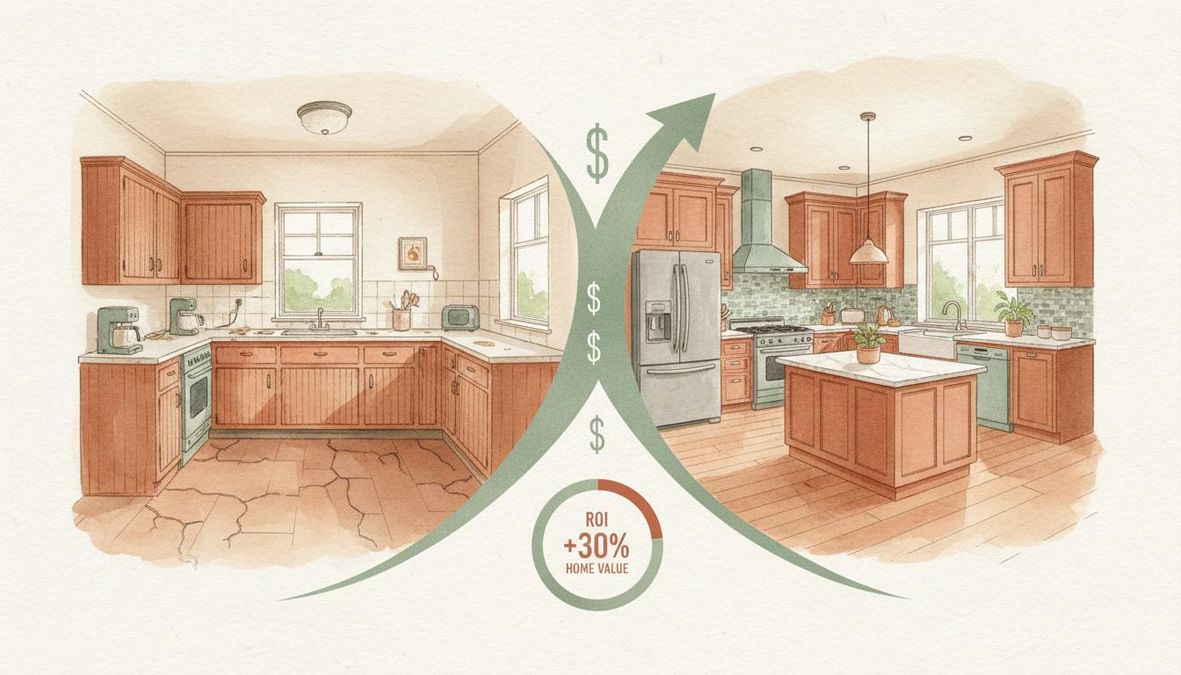
Every homeowner considering a kitchen remodel eventually asks the same question: “Will I get this money back when I sell?” The honest answer is usually no — not entirely. But that’s the wrong way to think about it. A kitchen remodel’s real return comes from years of daily enjoyment, easier entertaining, faster meal prep, and a space that genuinely fits your life. Any resale value is a bonus.
Still, the numbers matter — especially if you plan to sell within five years or if you’re borrowing against your home to fund the project. This guide breaks down national and regional ROI data, explains what drives value up or down, and tells you when a remodel financially makes sense versus when it doesn’t.
For personalized budget planning, see our kitchen remodel cost calculator. For financing options, check our guide to kitchen remodel financing.
National Average ROI: The Big Picture
According to Remodeling Magazine’s 2024 Cost vs Value report — the industry-standard benchmark for renovation ROI — kitchen remodels deliver different returns depending on scope:
| Remodel Type | Average Cost | Resale Value | ROI |
|---|---|---|---|
| Minor kitchen remodel (mid-range) | $27,000 | $22,000 | 81% |
| Major kitchen remodel (mid-range) | $48,000 | $35,000 | 73% |
| Major kitchen remodel (upscale) | $95,000 | $58,000 | 61% |
Source: Remodeling Magazine Cost vs Value Report, 2024 edition. Data represents national averages across 150 US markets.
The pattern is clear: smaller investments return a higher percentage. A $27,000 minor remodel returns 81 cents on the dollar. A $95,000 upscale remodel returns 61 cents. This doesn’t mean upscale remodels are bad — it means their value is primarily in your enjoyment, not your home’s resale price.
What Counts as “Minor” vs “Major”
Minor remodel: Cabinet refacing or replacement (stock/entry-level), new countertops (laminate or entry quartz), new sink and faucet, new appliances (budget to mid-range), fresh paint, new flooring. Layout stays the same. No structural changes.
Major remodel (mid-range): New semi-custom cabinets, solid surface countertops, quality appliances, new flooring, fresh paint, possible minor layout changes. May include new lighting and a backsplash.
Major remodel (upscale): Custom cabinets, stone countertops, professional-grade appliances, structural changes (removing walls, adding island), high-end flooring, designer lighting, potential plumbing/electrical upgrades.
ROI by US Region
Where you live significantly affects your return. Housing market dynamics, local labor costs, and buyer expectations all play a role.
| Region | Minor Remodel ROI | Major (Mid-Range) ROI | Major (Upscale) ROI |
|---|---|---|---|
| Pacific (CA, WA, OR, HI, AK) | 85–95% | 72–82% | 58–68% |
| Mountain (NV, AZ, UT, CO, ID, MT, WY, NM) | 80–88% | 70–78% | 58–66% |
| South Atlantic (FL, GA, SC, NC, VA, WV, DC, MD, DE) | 78–85% | 68–75% | 56–63% |
| West South Central (TX, OK, AR, LA) | 75–82% | 65–72% | 54–62% |
| West North Central (MN, IA, MO, ND, SD, NE, KS) | 74–80% | 64–70% | 52–60% |
| East North Central (IL, IN, OH, MI, WI) | 76–82% | 66–72% | 54–62% |
| East South Central (KY, TN, MS, AL) | 74–80% | 64–70% | 52–58% |
| Middle Atlantic (NY, NJ, PA) | 82–90% | 70–78% | 58–66% |
| New England (ME, NH, VT, MA, RI, CT) | 80–88% | 70–78% | 58–66% |
Source: Remodeling Magazine Cost vs Value Report, 2024. Regional ranges reflect variation within each region’s primary metro markets.
Why the Pacific Region Leads
The Pacific region consistently shows the highest kitchen remodel ROI for two reasons. First, home values are high — a $50,000 kitchen in a $1.2 million home is proportionally reasonable, and buyers expect updated kitchens. Second, housing inventory is tight, so buyers compete for move-in-ready homes and pay a premium for updated kitchens rather than discounting for renovation needs.
Why Upscale Remodels Lag Everywhere
Upscale kitchen remodels return less because buyers rarely pay full value for someone else’s luxury preferences. Your $15,000 range and $8,000 refrigerator are meaningful to you — but a buyer sees “nice appliances” and mentally adds maybe $5,000–$8,000 to their offer, not $23,000. The lesson: remodel for your life, not for a hypothetical future buyer’s taste.
What Improves Your ROI
Staying appropriate for your neighborhood. The biggest ROI killer is over-improving. A $100,000 kitchen in a neighborhood where homes sell for $300,000–$400,000 won’t return its cost — buyers for that price range won’t pay a premium that reflects your investment. A $100,000 kitchen in a $1 million home? Reasonable, and buyers expect it.
Focusing on what buyers see. Cabinets, countertops, and appliances drive perceived value far more than the infrastructure behind them. A new electrical panel is essential and expensive — but buyers don’t pay extra for it because they can’t see it. Allocate visible-dollar spending strategically.
Quality installation. Poor craftsmanship kills ROI faster than any material choice. Gaps between cabinets and walls, uneven countertop seams, misaligned drawer fronts — these signal “cheap renovation” to buyers and appraisers. Hire licensed, reviewed contractors even if they cost more upfront.
Time in the home. The longer you stay, the less ROI matters. A kitchen you enjoy for 15 years delivers its value in daily use, not resale. ROI calculations become relevant only when you’re selling within 3–7 years of the remodel.
Neutral, timeless design. Bold color choices and ultra-trendy finishes date quickly. White, gray, and natural wood tones have staying power. A kitchen that looks current 10 years after renovation protects your investment better than one that was Instagram-perfect for 18 months.
What Hurts Your ROI
Over-improving for the neighborhood. We said it above but it bears repeating: the #1 ROI mistake is spending beyond what your market supports. Check recent comparable sales in your neighborhood. If none have $80,000 kitchens, yours probably won’t recover that investment either.
DIY disasters. We support DIY enthusiasm — for painting, backsplash tile, cabinet hardware. But homeowners who DIY electrical, plumbing, or structural work often create problems that professional remediation costs 2–3x more to fix. Worse, unpermitted work can derail a sale when the buyer’s inspector finds it.
Neglecting the rest of the house. A $60,000 kitchen in a home with a leaking roof, outdated HVAC, and original windows sends a confusing message to buyers. They’ll wonder what else was neglected and may discount the kitchen’s value entirely.
Ultra-personalized features. That built-in espresso machine, the wine cellar under the island, the specialized baking station — perfect for you, potentially irrelevant to buyers. These features add cost without adding comparable value.
Poor contractor selection. The lowest bid is rarely the best value. Contractors who underbid often cut corners, use substandard materials, or disappear mid-project. The resulting quality issues show up at sale time in inspection reports and buyer negotiations.
When a Kitchen Remodel Doesn’t Pay Off
There are legitimate scenarios where remodeling your kitchen is financially unwise:
You’re selling within 2 years. The market won’t have time to absorb your investment, and you’ll eat most of the cost. Better to do a $5,000 refresh — paint, hardware, maybe countertops — and let the next owner remodel to their taste.
Your home is already at neighborhood ceiling. If your home is among the most expensive on the block, a kitchen remodel won’t push the sale price higher. Buyers compare to neighbors, and they won’t pay significantly more for your house regardless of how nice the kitchen is.
You need the money for structural priorities. Roof, foundation, HVAC, electrical panel, plumbing — these systems protect your home’s value in ways a kitchen can’t. If your roof is 25 years old, replace it before you replace your cabinets.
You’re using high-interest debt. Financing a kitchen remodel on a credit card at 22% APR only makes sense if you’re selling immediately and the remodel directly increases your sale price enough to cover the interest. Otherwise, the carrying costs erode any potential return.
The Real Value: Livability Over Resale
Here’s the honest truth most ROI articles won’t tell you: kitchen remodels are lifestyle investments, not financial ones. A family that cooks dinner together every night gets more value from a functional island than from any percentage return calculation. Someone who loves to bake gets irreplaceable joy from a proper baking station with marble counters and a double oven.
If you plan to stay in your home for 7+ years, stop obsessing over ROI percentages. Build the kitchen that fits your life. Get three quotes, hire a good contractor, stay within a budget you can afford, and enjoy the result every single day. The resale value will be whatever it is — and you’ll have already gotten your money’s worth.
For help estimating your total project budget — including realistic ROI expectations for your specific home value and location — try our kitchen remodel cost calculator.