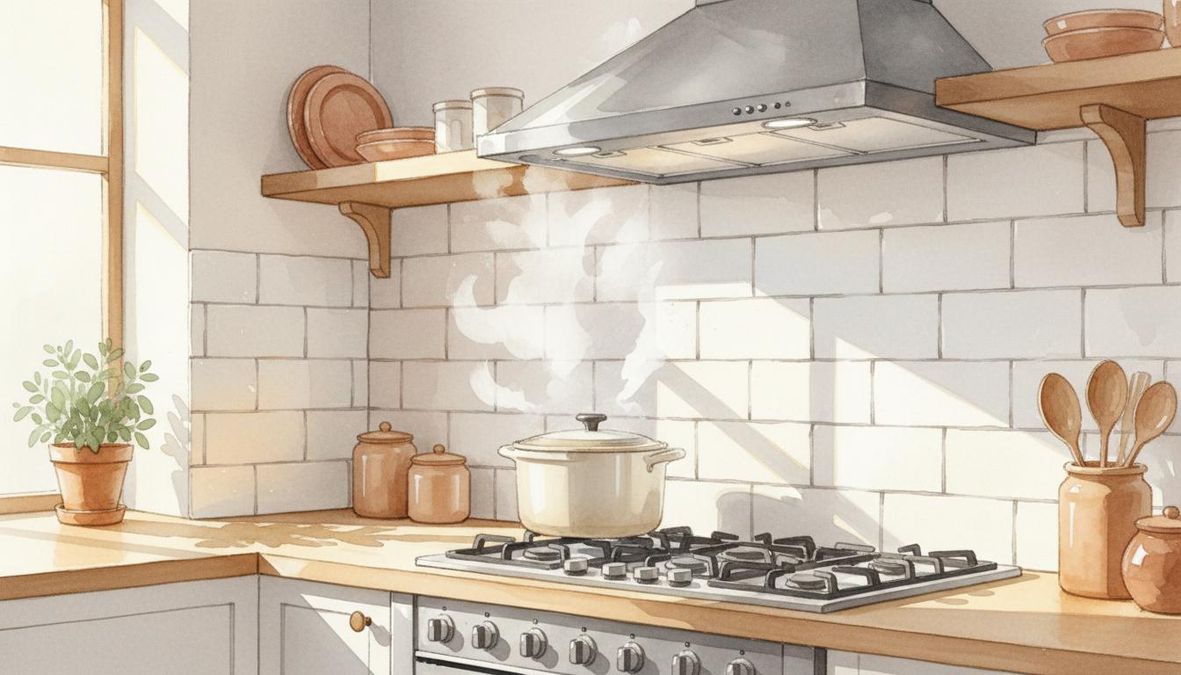
A new kitchen range hood costs $200–$2,500 plus $200–$1,000 to install. Here’s a cost guide for under-cabinet, wall-mount, island, and downdraft hoods.
Walk through any kitchen showroom and you’ll see gleaming refrigerators and professional gas ranges. But the range hood? It’s usually tucked above the display, barely noticed. That’s a mistake. Your range hood affects air quality, cooking comfort, and long-term kitchen maintenance. Understanding kitchen range hood cost before you remodel keeps your project on budget and your kitchen properly ventilated.
Range hood pricing splits into two parts: the unit and installation. The unit runs $150 for a basic under-cabinet model to $3,000 for a premium downdraft system. Installation adds $200–$1,200 depending on type, ductwork complexity, and local labor. Pick the wrong hood and you’ll either overspend on power you don’t need or end up with a kitchen that still smells like last night’s salmon.
This guide covers the four main types, what each costs, how to size one correctly, and where it fits into your broader kitchen appliance package cost and overall renovation budget.
How Much Does a Kitchen Range Hood Cost by Type?
Here’s what you can expect to pay for the unit and professional installation for each type.
Under-Cabinet Range Hoods
Unit cost: $150–$800 | Installation: $200–$500
Under-cabinet hoods mount beneath your existing cabinetry above the cooktop. They’re the most common and most affordable option, making them the default choice in most builder-grade kitchens and modest renovations.
Ducting typically runs straight back through the wall or up through the cabinet, keeping installation straightforward. Basic models at $150–$300 offer 200–400 CFM and simple push-button controls. At $400–$800, you get better motors, quieter operation, LED lighting, and stainless steel finishes that last.
The downside is aesthetic. Under-cabinet hoods look utilitarian, which may clash with a modern or high-end kitchen design.
Wall-Mount (Chimney) Range Hoods
Unit cost: $400–$2,000 | Installation: $300–$700
Wall-mount chimney hoods attach directly to the wall and extend upward like a stovepipe, making them a visual feature rather than something you try to hide. They work in kitchens where there are no upper cabinets above the cooking surface.
Chimney hoods start around $400 for a basic stainless model with 400–600 CFM. The $800–$1,500 range gets you better airflow, baffle filters, quieter motors, and cleaner lines. Premium brands past $2,000 add features like heat-sensing auto-adjust and custom finishes.
Installation is more involved than under-cabinet. The hood needs secure wall anchoring, ductwork routed through an exterior wall or ceiling, and finish work around the chimney cover. If your kitchen lacks existing ducting in the right place, expect costs toward the higher end.
Island Range Hoods
Unit cost: $600–$2,500 | Installation: $500–$1,000
Island hoods hang from the ceiling above a cooktop located on a kitchen island. Because there’s no wall behind the range, these hoods need more power and more extensive ductwork to capture smoke and odors effectively.
Island hoods need higher CFM ratings since air circulates on all four sides rather than being blocked by a wall. Ductwork must run through the ceiling and potentially across floor joists before reaching an exterior wall. That extra labor pushes installation toward $500–$1,000, and complex routing can push it higher.
Budget $600–$1,200 for a decent mid-range island hood with 600–900 CFM. Models above $1,500 typically offer 1,000+ CFM, sleek glass or custom finishes, and very low sone ratings. Because island hoods are so visible, many homeowners treat them as a design statement.
Factor this cost into your broader kitchen island cost and design planning early. Moving ductwork after the island is built is expensive.
Downdraft Ventilation Systems
Unit cost: $800–$3,000 | Installation: $500–$1,200
Downdraft systems sit flush with the countertop and rise behind the cooktop when needed, pulling air downward rather than upward. They’re the go-to option when you want to eliminate overhead ventilation entirely — common on islands where a hanging hood would block sightlines or in open-concept kitchens where overhead ducting isn’t feasible.
Downdraft units start around $800. The $1,500–$2,500 range covers most residential models with adequate airflow for moderate cooking. Above $2,500, you get systems integrated into the cooktop with seamless controls and extraction powerful enough for serious gas cooking.
Installation is the most complex of any hood type. Ductwork runs down through the cabinet below the cooktop, across the floor, and out through a wall or the foundation. In slab-on-grade homes, this can mean cutting concrete or redesigning cabinets. That’s why installation runs $500–$1,200 and occasionally more.
There’s also a performance tradeoff. Even the best downdraft systems can’t match the capture efficiency of an overhead hood because hot air naturally rises. If you do heavy stir-frying, wok cooking, or lots of pan-searing, a downdraft may leave your kitchen smokier than you’d like.
What Size Range Hood Do You Need? Sizing by CFM
CFM stands for cubic feet per minute — the volume of air your hood moves. Get this wrong and your expensive hood won’t clear the air.
For gas cooktops, use 10 CFM per 1,000 BTU of total burner output. A typical 50,000 BTU gas range needs roughly 500 CFM minimum. Pro-style ranges at 90,000–120,000 BTU need 900–1,200 CFM.
For electric cooktops, use 100 CFM per linear foot of cooktop width. A 30-inch electric range needs about 250 CFM; a 36-inch needs around 300 CFM.
Practical minimums:
- Standard electric range (30 in.): 250 CFM
- Standard gas range (30 in., ~40,000 BTU): 400 CFM
- Pro-style gas range (36–48 in., 60,000–90,000 BTU): 600–900 CFM
- High-BTU or wok cooking: 1,000+ CFM
Go higher than the minimum if you cook frequently with high heat or fry often. But don’t max out CFM for bragging rights. Hoods above 400 CFM may require make-up air systems per building code, adding $500–$2,000. Check local requirements before specifying a 1,200 CFM unit.
Ducted vs. Ductless Range Hoods: Which Is Better?
Ducted hoods vent air outside through metal ductwork. Ductless hoods recirculate air back into the kitchen through charcoal filters. The difference matters for cost and performance.
Ducted systems actually remove heat, moisture, grease, and odors rather than just masking them. Any hood above 400 CFM is almost always ducted. The downside is installation complexity — you need a path to the exterior, which isn’t always easy in apartments or interior kitchens.
Ductless systems are cheaper to install since they don’t need exterior ductwork. But charcoal filters need replacement every 3–6 months ($20–$50 per set), and they don’t remove heat or moisture. They’re fine for light electric cooking where ducting isn’t possible. For gas cooking or anything beyond basic meal prep, ducted is the better call.
Some under-cabinet models convert between ducted and ductless operation, giving you flexibility if you remodel later.
How Loud Is Too Loud? Understanding Sone Ratings
Range hood noise is measured in sones, not decibels. One sone equals the sound of a quiet refrigerator. Most homeowners find hoods at 3.0 sones or less comfortable for normal conversation. Hoods above 6 sones force you to raise your voice.
Here’s the scale:
- Under 2 sones: Very quiet. You can talk easily. Typical of premium hoods at low speed.
- 2–4 sones: Moderate. Noticeable but not intrusive. Fine for most households.
- 4–6 sones: Loud. Competes with conversation. Typical of budget hoods at full power.
- Over 6 sones: Very loud. You’ll want to turn it off immediately after cooking.
Most hoods have multiple speeds. A unit might run at 1.5 sones on low and 7 sones on high. Check the rating at the speed you’ll use daily, not just the marketing number on the box. If you cook daily, budget for a hood with a quiet low speed and reserve the roar for occasional high-heat sessions.
Higher CFM hoods tend to be louder, but better engineering can move more air with less noise. Baffle filters reduce turbulence compared to older mesh designs, cutting noise while improving grease capture.
Range Hood Brands by Price Tier
The range hood market spans from big-box brands to custom showpieces.
Budget ($150–$500): Broan-NuTone, Cosmo, Hauslane, Winflo. Broan dominates this segment. These units handle basic cooking with functional build quality. Expect 3–7 sones and 200–450 CFM.
Mid-range ($500–$1,500): Zephyr, Faber, Kobe, Ancona. This is the sweet spot for most homeowners. You get better motors, quieter operation (2–4 sones), stainless construction, and improved aesthetics. Zephyr offers particularly strong design variety.
Premium ($1,500–$3,000+): Wolf, Viking, Thermador, Best by Broan. These pair with pro-style appliance suites and offer the highest CFM, quietest operation, and best build quality. Wolf and Thermador hoods integrate visually with their ranges and often include automatic heat-sensing speed adjustment.
For most homeowners, a mid-range hood from Zephyr or Faber delivers the best balance of performance, noise control, and reliability. Budget brands work fine for occasional cooking. Premium brands make sense with a pro appliance package where visual cohesion matters.
Kitchen Range Hood Cost Comparison Table
| Hood Type | Unit Cost | Install Cost | Total Project Cost | CFM Range | Best For |
|---|---|---|---|---|---|
| Under-cabinet | $150–$800 | $200–$500 | $350–$1,300 | 200–600 | Standard kitchens with cabinets above range; budget renovations |
| Wall-mount / chimney | $400–$2,000 | $300–$700 | $700–$2,700 | 400–1,200 | No upper cabinets above cooktop; visual statement piece |
| Island | $600–$2,500 | $500–$1,000 | $1,100–$3,500 | 600–1,500 | Island cooktops; open floor plans |
| Downdraft | $800–$3,000 | $500–$1,200 | $1,300–$4,200 | 300–1,100 | Sightline-critical designs; no overhead duct path |
Installation costs include basic ductwork. Complex routing, make-up air systems, or electrical upgrades cost extra. Prices vary by region — get local quotes for your specific layout.
How Range Hood Costs Fit Into Your Total Kitchen Budget
A range hood typically represents 2–5% of a full kitchen remodel budget. In a $50,000 renovation, spending $800–$1,500 on a mid-range hood with installation is proportionate. In a $100,000+ project, a $2,000–$3,500 island or premium wall-mount hood makes sense.
Don’t treat the hood as an afterthought. Poor ventilation leads to lingering odors, grease buildup on cabinets, and excess moisture that damages finishes over time. Spending an extra $300–$500 on the right hood pays off in kitchen longevity.
Use a kitchen remodel cost calculator to see how the hood fits alongside cabinets, countertops, and appliances. Planning the full budget together prevents overspending on visible finishes while under-allocating on ventilation.
Installation Cost Factors That Drive the Price Up
Several conditions push installation toward the high end:
- New ductwork path: Running duct through finished ceilings, walls, or floors adds labor. Each bend reduces efficiency, so straight paths are best but not always possible.
- Make-up air requirements: Many building codes require make-up air systems for hoods over 400 CFM. This brings outside air in to replace what’s exhausted, preventing negative pressure. Budget $500–$2,000 if this applies.
- Electrical upgrades: High-CFM hoods may need dedicated 20-amp circuits. Adding a circuit runs $200–$500 if your panel has space.
- Exterior penetration: Cutting through siding, brick, or roofing for the vent cap adds $100–$400.
- Downdraft complexity: Any downdraft install involving concrete work or cabinet modification quickly escalates past $1,000.
Discuss ventilation early in the design phase with your contractor. It’s far cheaper to plan duct routes before drywall goes up than to retrofit later.
Final Thoughts on Kitchen Range Hood Cost
Range hoods don’t get the attention they deserve in kitchen planning, but they’re one of the few appliances that affects your home daily — in air quality, comfort, and long-term maintenance of cabinets and finishes.
The kitchen range hood cost for most homeowners falls between $500 and $2,500 installed, depending on hood type, CFM needs, and installation complexity. Under-cabinet hoods handle most standard kitchens affordably. Wall-mount and island hoods serve design-forward layouts. Downdraft systems solve specific constraints but demand the highest budget and come with real performance tradeoffs.
Prices vary widely by region. Labor runs higher in major metro areas and on complex retrofits. These ranges are ballpark figures based on national averages. For your specific layout, get quotes from at least two licensed contractors who can assess duct paths, electrical needs, and local code requirements.
If you purchase through retailer links on this page, we may earn a commission, at no extra cost to you.