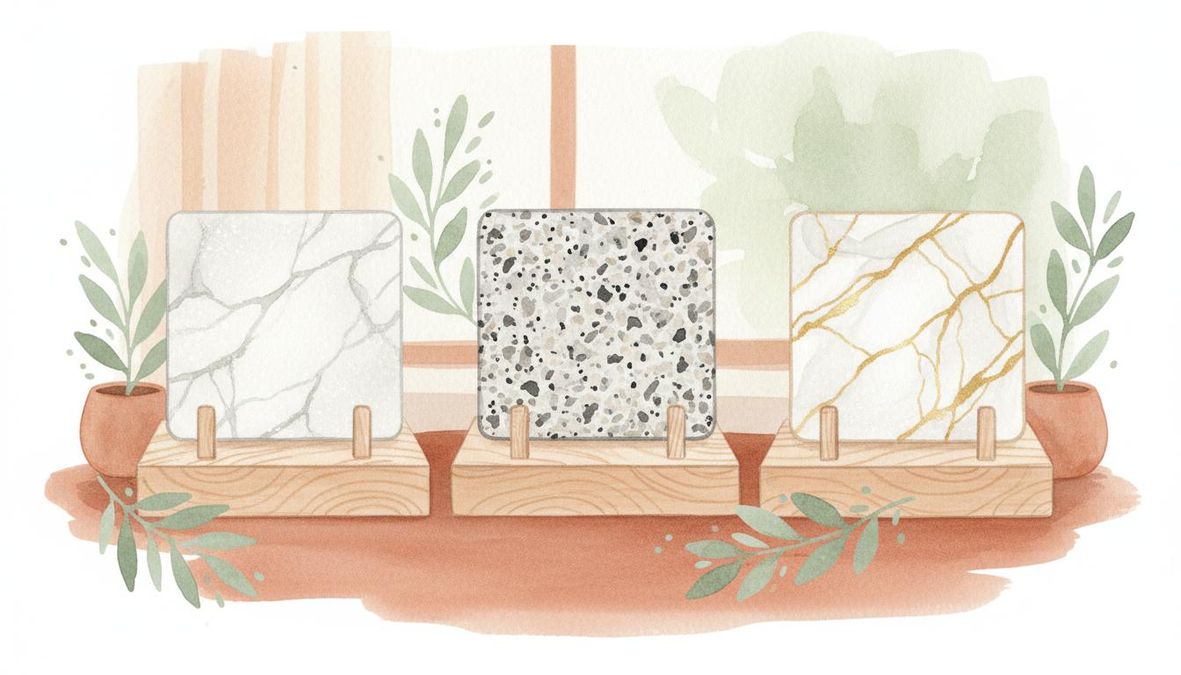
Countertops are the second-biggest cosmetic decision in your kitchen — and the surface you interact with most. Every meal prep, every coffee cup, every cleanup touches this surface. Choosing the wrong material means years of maintenance headaches or premature replacement. Choosing the right one means a surface that looks beautiful and performs flawlessly for decades.
The five main countertop materials for US kitchens are quartz, granite, marble, laminate, and butcher block. Each has a distinct cost profile, maintenance requirement, and aesthetic personality. This guide compares them honestly — no material is perfect for every household.
For context on how countertops fit into your overall budget, see our breakdown of kitchen remodel cost by tier. If you’re pricing cabinets alongside counters, our kitchen cabinet cost guide covers that side of the equation.
Kitchen Countertop Cost Comparison (2026 Prices)
Here’s what installed countertops cost per square foot in 2026, from cheapest to most expensive:
| Material | Cost per sq ft (installed) | Maintenance | Heat resistant |
|---|---|---|---|
| Laminate | $20 – $40 | Very low (wipe clean) | No |
| Butcher block | $40 – $80 | Regular oiling | No |
| Granite | $40 – $100 | Annual sealing | Yes |
| Quartz | $50 – $120 | None (no sealing) | No |
| Marble | $60 – $150 | High (seal + accept patina) | Yes |
Quick take: For a typical 30 sq ft kitchen (25 linear feet of counter), you’ll spend $600–$1,200 on laminate, $1,200–$3,000 on granite or butcher block, $1,500–$3,600 on quartz, or $1,800–$4,500 on marble — installed, including standard edge profiles.
Which is cheapest? Laminate is the least expensive countertop material at $20–$40 per square foot installed. Granite is the least expensive natural stone at $40–$100/sf.
Which is most expensive? Marble is the most expensive of the common countertop materials at $60–$150/sf installed, with premium Calacatta and Statuario marbles running $200+/sf.
Which is the best value? Mid-range quartz at $60–$90/sf offers the best balance of durability, low maintenance, and resale appeal for most kitchens.
Quartz Countertops
Quick answer: Quartz costs $50–$120 per square foot installed, requires no sealing or special maintenance, and resists scratches and stains better than any natural stone. It’s the best all-around choice for busy kitchens where low maintenance matters more than natural character.
Cost: $50 – $120 per square foot installed
Quartz — technically engineered stone — dominates the US kitchen market for good reason. It’s 90–95% ground natural quartz bound with resins and pigments, creating a non-porous, consistent surface that performs better than most natural stone.
Why choose quartz?
Nearly maintenance-free. No sealing, ever. Wipe with soap and water. That’s it. For busy households, this single advantage outweighs almost everything else.
Consistent appearance. What you see in the sample is what you get on your island. No surprise veining, no unexpected mineral deposits, no weak spots. This predictability makes quartz ideal for modern and transitional kitchens where consistency matters.
Hygienic. Non-porous means bacteria, mold, and stains can’t penetrate the surface. Food-safe without special cleaners.
Durable. Quartz resists scratches, chips, and cracks better than marble and most granites. It’s not indestructible — excessive heat can damage the resin binders — but it’s forgiving for normal kitchen use.
What are the downsides of quartz?
Heat sensitivity. Placing a hot pan directly on quartz can discolor or crack the resin. You need trivets or hot pads — every single time. For serious cooks who move hot pans from stove to counter constantly, this is a genuine inconvenience.
Less character. The uniformity that makes quartz predictable also makes it less unique. Your neighbor’s Calacatta quartz looks identical to yours. Some homeowners find this sterile; others find it reassuring.
UV sensitivity. Direct sunlight over years can yellow or fade some quartz colors. Not an issue for most kitchens, but worth considering if you have a south-facing wall of windows and no shades.
Best quartz brands
| Brand | Price Range | Notes |
|---|---|---|
| Cambria | $$$–$$$$ | American-made. Premium designs. Lifetime warranty. Exclusive dealer network. |
| Caesarstone | $$–$$$ | Israeli manufacturer. Wide color range. Good mid-tier value. |
| Silestone | $$–$$$ | Spanish brand (Cosentino group). Integrated Microban. Strong distribution. |
| MSI Q | $–$$ | Budget-friendly. Good basics. Wider color variation between batches. |
| LG Hausys (Viatera) | $$–$$$ | Korean manufacturer. Competitive pricing. Good quality control. |
Granite Countertops
Quick answer: Granite costs $40–$100 per square foot installed. It’s the most heat-resistant common countertop material, offers unique natural veining, and lasts 30+ years — but requires annual sealing to prevent staining from oil, wine, and acidic foods.
Cost: $40 – $100 per square foot installed
Granite was the luxury standard before quartz existed, and it remains a excellent choice — especially at the mid-range and upper tiers where you can afford higher-grade slabs with dramatic movement and mineral patterns.
Why choose granite?
Natural beauty. No two slabs are identical. The veining, flecks, and color variations in a high-grade granite slab are genuinely irreplaceable — quartz tries to imitate this, but there’s no substitute for the real thing.
Heat resistant. You can set a hot pan on granite without damage. Not recommended as a regular practice, but granite won’t crack or discolor from occasional heat exposure.
Longevity. A well-maintained granite countertop lasts 30+ years. Many homeowners never replace granite unless they’re changing the kitchen’s color scheme entirely.
Value retention. Granite still carries prestige in the real estate market. “Granite countertops” remains a keyword in listing descriptions because buyers respond to it.
What are the downsides of granite?
Requires sealing. Granite is porous. Without annual sealing, it stains — especially from oil, wine, and acidic foods like lemon juice and vinegar. The sealing process takes 30 minutes and costs $1–$2 per square foot if DIY, but it’s a task you can’t skip.
Inconsistent appearance. The slab you fall in love with at the stone yard might not match the rest of your kitchen as well as you thought. Always view your actual slab — not just a sample — before fabrication begins.
Crack vulnerability. Granite can crack under heavy impact, especially at cutouts for sinks and cooktops. Repair is possible but visible — and expensive ($200–$500 per repair).
Where to buy granite
| Source | Price Range | Notes |
|---|---|---|
| Local stone yards | $$–$$$ | Best selection of unique slabs. Negotiate on remnant pieces for smaller projects. |
| Home Depot / Lowe’s | $$ | Limited selection but competitive pricing. Good for common colors like Ubatuba or Santa Cecilia. |
| Costco (seasonal) | $$–$$$ | Periodic sales with installation included. Must act fast — limited availability windows. |
We may earn a commission if you purchase through these links, at no extra cost to you.
Marble Countertops
Quick answer: Marble costs $60–$150 per square foot installed and is the most expensive common countertop material. It’s the most beautiful, stays naturally cool for baking, but etches from acids and stains from wine, coffee, and oil within minutes if not sealed regularly. Best used on baking stations or accent surfaces, not full kitchens.
Cost: $60 – $150 per square foot installed
Marble is the most beautiful and the most demanding kitchen countertop material. It’s what you see in European kitchens, high-end bakeries, and architectural magazines. It’s also the material most likely to stress out a perfectionist homeowner.
Why choose marble?
Unmatched aesthetics. The veining, the depth, the way light plays across a honed marble surface — nothing else looks like it. Carrara, Calacatta, and Statuario marbles are genuinely stunning.
Naturally cool. Marble stays cooler than room temperature, which makes it ideal for baking and pastry work. Professional bakers use marble slabs for this exact reason.
Develops character. A marble countertop with years of patina tells a story. The etching, the subtle staining, the wear patterns — some homeowners love this living finish. Others find it distressing.
What are the downsides of marble?
Extremely porous. Marble stains from wine, coffee, oil, citrus, and tomato sauce — often within minutes. Etching (dull spots from acid contact) happens constantly. If you want marble to look pristine, you’ll be fighting a losing battle every day.
Soft and scratch-prone. Marble scores 3–4 on the Mohs hardness scale (quartz is 7, granite 6–7). Knives scratch it. Heavy pots chip it. Sand and grit will dull the finish over time.
High maintenance. Annual sealing is mandatory. Some homeowners seal marble every 3–6 months. Even then, etching and staining are inevitable — you learn to live with them, or you don’t choose marble.
Where Marble Makes Sense
A baking station or pastry counter on an island. A powder room vanity. A butler’s pantry that sees light use. Marble is best in areas where aesthetics outweigh durability demands — or where the homeowner genuinely embraces patina as character.
Laminate Countertops
Quick answer: Laminate costs $20–$40 per square foot installed, making it the cheapest countertop material. Modern high-pressure laminates convincingly mimic stone at a fraction of the cost. Wipe-clean, no sealing, but not heat resistant and lower resale appeal than stone.
Cost: $20 – $40 per square foot installed
Laminate has come a long way. Modern high-pressure laminates (Formica 180fx, Wilsonart HD) convincingly mimic stone and wood at a fraction of the cost. For budget remodels and rental properties, laminate is the pragmatic choice.
Why choose laminate?
Extremely affordable. A full kitchen of laminate countertops costs less than a single slab of premium quartz. This leaves budget room for cabinets, appliances, or labor upgrades.
Low maintenance. Wipe clean, no sealing, reasonably stain-resistant. Laminate handles daily kitchen use without complaint.
Lightweight. Easier DIY installation than stone. If you’re handy and patient, you can install laminate yourself with basic tools.
What are the downsides of laminate?
Not heat resistant. Hot pans will scorch laminate — irreparably. You’ll need trivets for life.
Vulnerable to scratches and chips. Laminate can’t be refinished like stone. A deep scratch or chip means replacement of the entire section.
Visible seams. Unlike stone, which can be joined nearly invisibly by skilled fabricators, laminate seams are always visible to some degree.
Lower resale appeal. “Laminate countertops” doesn’t excite buyers the way “quartz” or “granite” does. For a home you plan to sell within 3–5 years, this matters.
Butcher Block Countertops
Quick answer: Butcher block costs $40–$80 per square foot installed. It’s the only countertop material that can be sanded and refinished, adds warmth to a kitchen, and works well for casual or farmhouse styles. Requires monthly oiling and immediate cleanup of standing water.
Cost: $40 – $80 per square foot installed
Butcher block — typically maple, oak, or walnut — brings warmth and a casual, farmhouse feel to kitchens. It’s the only countertop material that improves with use and can be completely renewed.
Why choose butcher block?
Repairable. Sand out scratches, burns, and stains, then re-oil. Your butcher block can look brand new 10 years in — something no stone countertop can claim.
Warm underfoot and to the touch. Unlike stone, butcher block doesn’t feel cold in winter. It’s pleasant to lean against and work on.
Affordable warmth. Butcher block costs less than mid-range quartz or granite while delivering a high-end aesthetic in the right kitchen.
What are the downsides of butcher block?
Requires regular oiling. Monthly mineral oil application (or as directed by the manufacturer) prevents warping, cracking, and bacterial growth. Skip this maintenance and your butcher block suffers.
Water damage risk. Standing water around the sink will eventually cause problems — darkening, warping, or seam separation. You must be diligent about wiping up water immediately.
Not heat resistant. Hot pans will scorch wood. You’ll need trivets — same as laminate.
Countertop Material Comparison Table
| Material | Cost/sq ft | Durability | Maintenance | Heat Resistant | Best For |
|---|---|---|---|---|---|
| Quartz | $50–$120 | Excellent | Minimal (no sealing) | No | Busy families, low-maintenance households |
| Granite | $40–$100 | Very good | Annual sealing | Yes | Homeowners who want natural stone, heat tolerance |
| Marble | $60–$150 | Fair | High (seal + accept patina) | Yes | Baking enthusiasts, aesthetic-focused kitchens |
| Laminate | $20–$40 | Moderate | Minimal | No | Budget remodels, rentals, DIY projects |
| Butcher Block | $40–$80 | Good | Regular oiling | No | Farmhouse style, homeowners who enjoy maintenance |
Which Countertop Should You Choose?
What’s the lowest-maintenance countertop material?
Quartz is the lowest-maintenance countertop material. No sealing required, ever. Wipe clean with soap and water. It resists stains, scratches, and bacteria without any special care. This single advantage is why quartz outsells granite in new US kitchens today.
What’s the best countertop for someone who cooks with high heat?
Granite is the best countertop for high-heat cooking. It can handle a hot pan directly from the stove without cracking or discoloring — quartz, laminate, and butcher block can’t. If you regularly move hot cast iron or roasting pans from stove to counter, granite is worth the annual sealing tradeoff.
What’s the best countertop for baking?
Marble is the best countertop for baking. It stays cooler than room temperature, which keeps butter and dough at working temperature longer. Most professional bakers use marble slabs for exactly this reason. Install a marble section on your island or as a dedicated baking counter, rather than throughout your whole kitchen.
What’s the cheapest countertop material?
High-pressure laminate is the cheapest countertop material at $20–$40 per square foot installed. Modern laminates (Formica 180fx, Wilsonart HD) convincingly mimic stone and wood. For budget remodels and rentals, laminate delivers the most functional counter surface per dollar.
What countertop material offers the best value?
Mid-range granite ($60–$80/sf) or entry-level quartz ($60–$80/sf) offers the best value. Both deliver 20+ year lifespans, strong resale appeal, and low daily maintenance at a price that fits most mid-range kitchen budgets ($15,000–$40,000 total remodel).
For a personalized budget estimate that includes countertops alongside cabinets, appliances, and labor, try our kitchen remodel cost calculator.